{domain:"www.qualitydigest.com",server:"169.47.211.87"} Skip to main content

        
User account menu
Main navigation
  • Topics
    • Customer Care
    • Regulated Industries
    • Research & Tech
    • Quality Improvement Tools
    • People Management
    • Metrology
    • Manufacturing
    • Roadshow
    • QMS & Standards
    • Statistical Methods
    • Resource Management
  • Videos/Webinars
    • All videos
    • Product Demos
    • Webinars
  • Advertise
    • Advertise
    • Submit B2B Press Release
    • Write for us
  • Metrology Hub
  • Training
  • Subscribe
  • Log in
Mobile Menu
  • Home
  • Topics
    • Customer Care
    • Regulated Industries
    • Research & Tech
    • Quality Improvement Tools
    • People Management
    • Metrology
    • Manufacturing
    • Roadshow
    • QMS & Standards
    • Statistical Methods
    • Supply Chain
    • Resource Management
  • Login / Subscribe
  • More...
    • All Features
    • All News
    • All Videos
    • Training

Oak Ridge National Laboratory Launches Next-Generation Data Centers Institute

Focusing on technologies to operate systems reliably while accelerating scientific breakthroughs

Amy Smotherman Burgess/ORNL, U.S. Dept of Energy

Oak Ridge National Laboratory
Bio
Wed, 03/18/2026 - 12:02
  • Comment
  • RSS

Social Sharing block

  • Print
Body

In response to the societal challenge of the growing electricity demand from AI data centers, Oak Ridge National Laboratory (ORNL) is launching the Next Generation Data Centers Institute (NGDCI). This internal ORNL institute will unite the laboratory’s unique expertise and facilities spanning energy technologies, high-performance computing, cybersecurity, and grid science to ensure that America’s rapidly growing AI infrastructure remains secure, efficient, and reliable.

ADVERTISEMENT

ORNL’s launch of NGDCI comes as the federal government advances its own national initiative: Genesis Mission. The Genesis Mission, led by the U.S. Department of Energy (DOE), calls for linking the nation’s most powerful computing resources with the energy systems that support them, doubling the productivity and impact of American research and development within a decade.

“Artificial intelligence is transforming every part of our society, but its energy appetite is unlike anything we’ve seen before,” says ORNL director Stephen Streiffer. “The electricity required to power AI data centers is expected to double or triple in the coming decade, straining infrastructure that is already under pressure. ORNL is uniquely positioned to meet this challenge.”

NGDCI supports the national mission to secure American energy dominance and deliver the science and technology needed to power, cool, operate, and secure AI infrastructure at scale. As ORNL prepares to deploy Discovery and Lux—next-generation AI supercomputer systems—NGDCI will focus on the technologies required to operate these systems reliably while accelerating scientific breakthroughs.

Tom King, ORNL grid infrastructure crosscut lead, with the transformers that serve the energy plant supporting the Frontier data center. Credit: Amy Smotherman Burgess/ORNL, U.S. Dept of Energy

Urgency and scale of the challenge

Data centers account for more than 4% of U.S. electricity use, and by 2030, that figure could climb as high as 17%, according to analysis by the Electric Power Research Institute. AI-specific workloads drive much of this growth: Training a single large language model can consume hundreds of megawatt-hours of electricity. The North American Electric Reliability Corp. warns that surging demand from AI and industrial electrification poses mounting risks to grid reliability.

Investment is rising accordingly. McKinsey estimates that global data center infrastructure spending will reach $7 trillion by 2030, with more than 40% in the United States.

“That scale of opportunity also exposes critical vulnerabilities in power, cooling, and advanced components. NGDCI will not only help U.S. industry capture this generational opportunity but also ensure that the supply chains underpinning it are secure and aligned with national interests,” Streiffer says.

As data center demand accelerates, the nation’s grid can’t absorb projected load growth without new approaches to planning and operation. Yet with intelligent integration—linking power, cooling, thermal management, workload scheduling, and AI-enabled forecasting—the next generation of data centers could shift from being stressors to becoming contributors to resilience.

NGDCI will tap into the capabilities of the lab’s Modeling Energy Growth Associated with Data Centers (MEGA-DC) project, which has created a multicriteria decision support platform. MEGA-DC models and forecasts the costs and economic benefits of implications of infrastructure upgrades needed by utilities, states, data center developers, and end-use consumers to help decision-makers identify pathways for scalable AI data center growth.

“We envision a future where data centers are national assets—adaptive, efficient, and strengthening the nation’s grid while fueling discovery and advancing America’s leadership in AI,” says ORNL’s Robert Wagner, associate laboratory director for energy science and technology.

Industry voices: A call to action

Companies throughout the AI and energy ecosystem, including AMD, Carrier Energy, Chemours, and NVIDIA, welcome the launch of NGDCI as a timely effort to address rapidly emerging challenges.

Forrest Norrod, executive vice president and general manager, Data Center Solutions Business Group, AMD: “AI is becoming critical infrastructure, and meeting that moment requires step-change gains in performance per watt and system reliability. For decades, national labs like ORNL have relied on close collaboration with the computing industry to advance high-performance computing, and the next generation of AI is redefining requirements at the intersection of compute, power, and the grid. NGDCI is designed to address those challenges at scale. Through tightly integrated co-design—from silicon to systems—AMD is collaborating with ORNL to develop power-aware, resilient architectures that support grid stability and enable more efficient AI at national scale.”

Hakan Yilmaz, president, Carrier Energy, and chief sustainability officer, Carrier: “As AI data centers become the factories of the digital age, efficient thermal management is becoming a defining requirement. We look forward to collaborating with ORNL’s new institute and bringing our expertise in thermal management and intelligent energy systems to help advance breakthrough next-generation cooling and heat-recovery technologies.” Yilmaz also serves on the ORNL ESTD Directorate Advisory Committee.

Nathan Blom, vice president of liquid cooling, Chemours: “We’re thrilled to partner with ORNL to shape the future of efficient AI infrastructure. As data center heat and energy demands surge, advanced thermal management—like two-phase liquid cooling—is no longer optional; it is essential for performance and reliability. At Chemours, we’ve seen firsthand how these technologies can dramatically reduce energy use and environmental impact while enabling next-generation computing. By combining ORNL’s leadership in energy and computing research with industry innovation, we can accelerate the adoption of innovative cooling solutions that strengthen grid resilience and America’s AI ambitions.”

Ian Buck, vice president of hyperscale and HPC, NVIDIA: ”NVIDIA has worked closely with leading U.S. labs, including Oak Ridge National Lab, for two decades to advance high-performance computing and scientific discovery across every domain while dramatically increasing energy efficiency. We’re excited to continue our scientific exploration with the administration’s Genesis Mission and NGDCI to better integrate AI infrastructure with the nation’s energy system, improving U.S. energy security.”

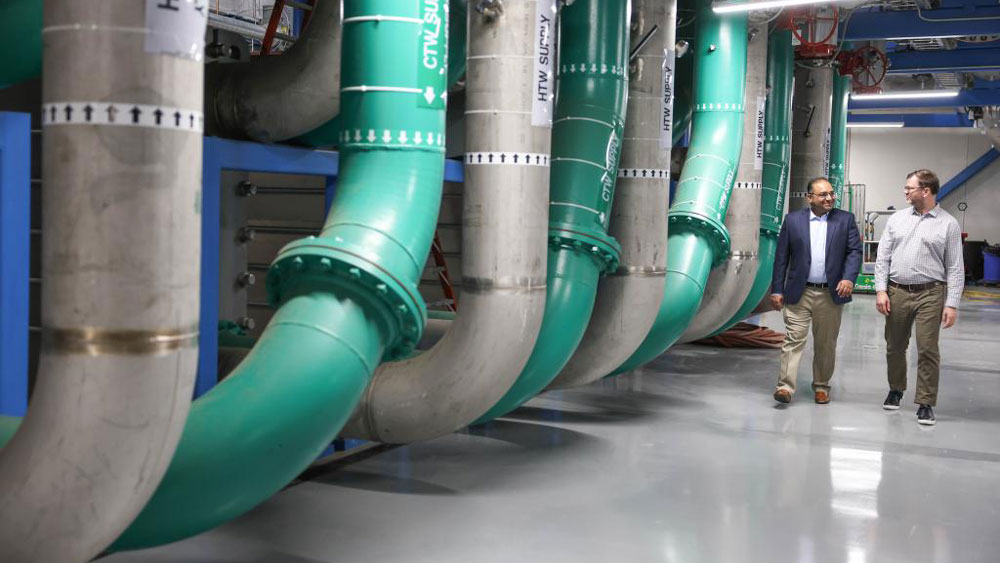
Kashif Nawaz, head of the Building Technologies Research Section, and Wes Brewer, senior research scientist in the National Center for Computational Sciences, walk through the energy plant that supports the Frontier data center. Credit: Amy Smotherman Burgess/ORNL, U.S. Dept of Energy

About NGDCI

“NGDCI aims to drive innovation that makes AI data centers more efficient, reliable, secure, and integrated with the nation’s energy system,” says Tom King, ORNL grid infrastructure crosscut lead. “It connects ORNL’s energy science, computing, and national security strengths while remaining flexible and collaborative with other national labs, industry, and utilities.”

The Oak Ridge Reservation has been selected by DOE as a site for advancing large-scale AI data center and energy generation projects, reflecting its suitability for hosting secure, reliable, and grid-supportive AI infrastructure on federally managed land.

ORNL’s leadership is built on decades of unique capability

Operational excellence at scale: ORNL is home to the Oak Ridge Leadership Computing Facility (OLCF), a DOE Office of Science user facility that houses the world’s first exascale supercomputer, Frontier. Managing one of the largest scientific data centers in the world provides unmatched insight into reliability, energy use, and system integration.

Unique testbeds: ORNL’s campus microgrid, thermal energy networks, and digital twin infrastructure allow researchers to validate new technologies before industry adoption.

MEGA-DC project leadership: MEGA-DC partners with states and utilities to support affordability, resilience, and long-term planning.

Science-to-application depth: ORNL integrates materials science, power systems, computing, manufacturing. and national security expertise across the full innovation continuum.

Research priorities

NGDCI will focus on six research areas.

Thermal management: Next-generation cooling from chip to system to reduce energy and water use, which today can account for 40%–60% of a data center’s total energy.

Power system architecture: Reimagining how energy flows from source to server, integrating direct current and new power electronics to reduce losses.

Grid integration: Designing data centers that stabilize rather than strain the grid, leveraging ORNL’s GRID-C testbeds and control systems.

Operations and load management: Intelligent, autonomous platforms for optimizing workloads and energy use.

Security: Extending cyber-informed engineering and quantum-safe communications into the physical and digital fabric of data centers.

Integrated systems modeling: System-of-systems models to anticipate how AI infrastructure will affect U.S. energy, jobs, materials and competitiveness through the 2030s and beyond.

National impact

NGDCI supports national goals to build the world’s most powerful scientific platform to accelerate discovery science, strengthen national security, and drive energy innovation. By aligning ORNL research capabilities, NGDCI can help identify the most urgent opportunity areas to help secure AI infrastructure and ensure the United States can build advanced AI systems on an energy foundation that is reliable and globally competitive.

For more information, visit energy.gov/science.

Published Feb. 26, 2026, by ORNL.

Add new comment

The content of this field is kept private and will not be shown publicly.
About text formats
Image CAPTCHA
Enter the characters shown in the image.

© 2026 Quality Digest. Copyright on content held by Quality Digest or by individual authors. Contact Quality Digest for reprint information.
“Quality Digest" is a trademark owned by Quality Circle Institute Inc.

footer
  • Home
  • Print QD: 1995-2008
  • Print QD: 2008-2009
  • Videos
  • Privacy Policy
  • Write for us
footer second menu
  • Subscribe to Quality Digest
  • About Us