{domain:"www.qualitydigest.com",server:"169.47.211.87"} Skip to main content

        
User account menu
Main navigation
  • Topics
    • Customer Care
    • Regulated Industries
    • Research & Tech
    • Quality Improvement Tools
    • People Management
    • Metrology
    • Manufacturing
    • Roadshow
    • QMS & Standards
    • Statistical Methods
    • Resource Management
  • Videos/Webinars
    • All videos
    • Product Demos
    • Webinars
  • Advertise
    • Advertise
    • Submit B2B Press Release
    • Write for us
  • Metrology Hub
  • Training
  • Subscribe
  • Log in
Mobile Menu
  • Home
  • Topics
    • Customer Care
    • Regulated Industries
    • Research & Tech
    • Quality Improvement Tools
    • People Management
    • Metrology
    • Manufacturing
    • Roadshow
    • QMS & Standards
    • Statistical Methods
    • Supply Chain
    • Resource Management
  • Login / Subscribe
  • More...
    • All Features
    • All News
    • All Videos
    • Training

How Remote Sensing and Aerial Imagery Can Improve Audit Accuracy

When taking to the air helps eliminate error

Dania Akram
Bio
Mon, 02/02/2026 - 12:03
  • Comment
  • RSS

Social Sharing block

  • Print
Body

Modern industrial and infrastructure environments are becoming larger, more complex, and more geographically dispersed. As facilities expand, internal audit teams face increasing pressure to deliver accurate, defensible findings within limited time frames. Traditional audit methods—largely dependent on ground-level inspections and manual documentation—often struggle to provide a complete picture of site conditions.

ADVERTISEMENT

This challenge is especially relevant for internal quality, operational, asset, and environmental health and safety (EHS) audits conducted in manufacturing plants, warehouses, logistics hubs, utilities, and infrastructure assets. These audits are typically carried out by internal audit teams, quality managers, risk professionals, or third-party auditors as part of routine oversight and continuous improvement efforts. They’re not intended to replace formal regulatory inspections, such as U.S. Food and Drug Administration audits, but rather to strengthen internal visibility, consistency, and decision-making.

Why traditional audit methods have limitations

Although they are essential, ground-based inspections come with practical constraints. Auditors might have limited access to rooftops, elevated structures, external perimeters, or expansive storage areas. Large sites often require selective sampling, increasing the risk that issues outside the sampled areas remain undocumented.

Additionally, manual note-taking and ad-hoc photography can lead to inconsistent records across audit teams or locations. These gaps can reduce the reliability of audit findings, slow corrective action planning, and make it harder to demonstrate due diligence during internal reviews or stakeholder discussions.

The role of remote sensing and aerial imagery in internal audits

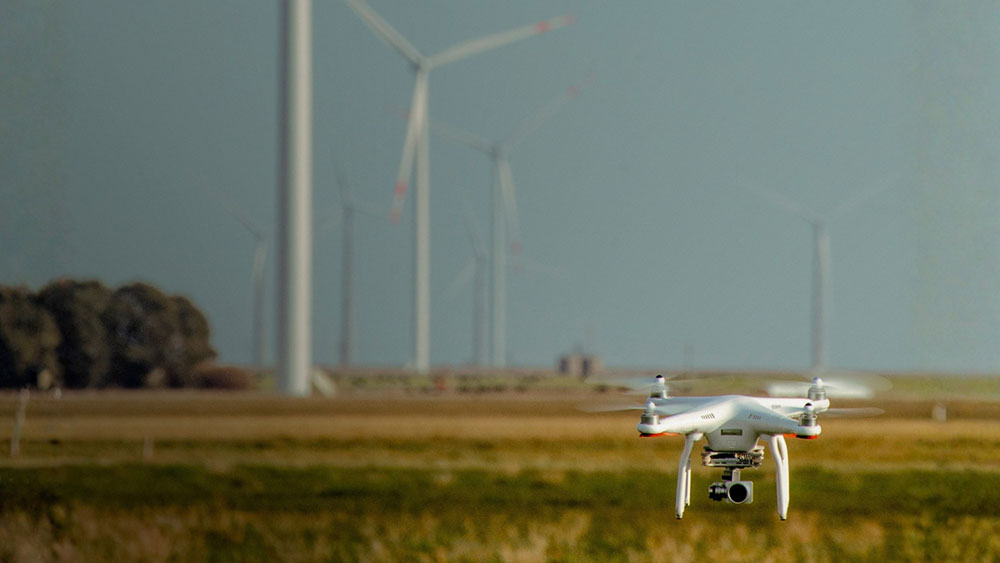
Remote sensing and aerial imagery introduce a complementary layer of visibility to internal audits. Using aerial platforms, auditors can capture high-resolution visual data of entire sites—both internal layouts and external conditions—without the access constraints of ground inspections.

Importantly, these tools aren’t substitutes for auditor judgment. Instead, they support it by providing objective, time-stamped visual evidence that auditors can review, analyze, and compare over time. This added context helps reduce subjectivity and strengthens the factual basis of audit conclusions.

Expanding coverage and improving consistency

Aerial imagery enables audit teams to observe site conditions from a unified perspective. Roof integrity, storage patterns, traffic flows, boundary conditions, and hard-to-reach infrastructure elements can all be reviewed without disrupting operations.

Because imagery is captured at specific points in time, it also creates a reliable historical record. Audit teams can compare current conditions with prior audit cycles to identify trends, emerging risks, or unresolved corrective actions. This consistency is particularly valuable in multisite audits, where maintaining uniform standards across locations is a common challenge.

Integrating aerial data into existing audit processes

Incorporating aerial data doesn’t require a complete redesign of audit frameworks. Instead, it works best when aligned with clearly defined audit objectives.

Audit teams can begin by identifying areas where visual verification adds value—such as asset condition assessment, compliance checks, or risk identification. Depending on the audit scope, different data types may be used. For example, thermal or elevation data, or imagery collected using a multispectral imaging drone, can help reveal issues that aren’t visible to the naked eye, including heat anomalies, material degradation, or uneven terrain.

Ground verification remains essential. Aerial observations should inform and guide onsite checks, not replace them. When documented properly, aerial visuals can be stored alongside traditional audit records to strengthen evidence and improve traceability.

Audit scenarios where aerial insights add the most value

Remote sensing is particularly effective in:
• Large-scale manufacturing and warehouse audits
• Multisite operational and quality reviews
• Infrastructure and asset-condition assessments
• Environmental and EHS evaluations
• Preinspection readiness and internal compliance reviews

In these contexts, organizations may rely on external providers through a drone as a service model to access aerial capabilities without maintaining in-house drone programs. This approach allows audit teams to apply aerial insights consistently across locations while keeping their focus on analysis and decision-making.

Benefits for internal audit and quality teams

When used appropriately, aerial imagery supports:
• More complete and accurate audit findings
• Reduced need for repeat audits or follow-up visits
• Stronger visual evidence for internal stakeholders
• Improved tracking of corrective actions over time
• Better inputs for continuous improvement initiatives

By shifting documentation from purely manual notes to structured visual records, auditors can spend more time interpreting findings and less time capturing them.

Practical limitations to consider

Aerial tools aren’t without constraints. Image quality can be affected by weather, lighting, or environmental conditions. Accurate interpretation requires trained professionals who understand both the technology and the audit context. Privacy considerations and local regulations must also be respected, particularly in populated or sensitive areas.

Successful use depends on careful planning, clear data governance, and alignment with audit objectives.

The future of internal auditing

As operational environments grow more complex, internal audits must evolve to maintain accuracy and credibility. Remote sensing and aerial imagery offer a practical way to enhance visibility, reduce blind spots, and strengthen audit evidence—without removing the human judgment that remains central to effective auditing.

Audit teams that thoughtfully integrate these tools into their existing processes will be better positioned to identify risks early, monitor change over time, and deliver findings that are both defensible and actionable.

Resources

UAVs and remote sensing for industrial inspection: Unmanned aerial vehicles are widely used for infrastructure inspection, monitoring, and assessment of hard-to-reach industrial assets, improving data consistency and safety.
ScienceDirect (Elsevier): https://www.sciencedirect.com/science/article/pii/S0926580518300165

Advantages of UAV remote sensing in large-scale assessments: AV-based remote sensing provides high-resolution imagery, flexible deployment, and multisensor data (optical, thermal, LiDAR), supporting more accurate condition assessments and risk identification.
Drones journal: https://www.mdpi.com/2504-446X/7/6/398

Use of drone technology in industrial and environmental monitoring: Drone remote sensing is increasingly adopted for monitoring, inspection, and data collection in industrial, infrastructure, and environmental applications.
ScienceDirect (Elsevier): https://www.sciencedirect.com/science/article/pii/S0920410521012675

You Might Like...
What's a 150-year Old Meat Chopper Have to do With America's Favorite Muscle Car?
How to Get Your Employees to Love Your Brand
How DIY AI Unlocks Productivity and Flexibility
Which KPIs Prove Your Maintenance Plan Is Working?
How to Reverse Engineer Classic Car Parts

Add new comment

The content of this field is kept private and will not be shown publicly.
About text formats
Image CAPTCHA
Enter the characters shown in the image.

© 2026 Quality Digest. Copyright on content held by Quality Digest or by individual authors. Contact Quality Digest for reprint information.
“Quality Digest" is a trademark owned by Quality Circle Institute Inc.

footer
  • Home
  • Print QD: 1995-2008
  • Print QD: 2008-2009
  • Videos
  • Privacy Policy
  • Write for us
footer second menu
  • Subscribe to Quality Digest
  • About Us