{domain:"www.qualitydigest.com",server:"169.47.211.87"} Skip to main content

        
User account menu
Main navigation
  • Topics
    • Customer Care
    • Regulated Industries
    • Research & Tech
    • Quality Improvement Tools
    • People Management
    • Metrology
    • Manufacturing
    • Roadshow
    • QMS & Standards
    • Statistical Methods
    • Resource Management
  • Videos/Webinars
    • All videos
    • Product Demos
    • Webinars
  • Advertise
    • Advertise
    • Submit B2B Press Release
    • Write for us
  • Metrology Hub
  • Training
  • Subscribe
  • Log in
Mobile Menu
  • Home
  • Topics
    • Customer Care
    • Regulated Industries
    • Research & Tech
    • Quality Improvement Tools
    • People Management
    • Metrology
    • Manufacturing
    • Roadshow
    • QMS & Standards
    • Statistical Methods
    • Supply Chain
    • Resource Management
  • Login / Subscribe
  • More...
    • All Features
    • All News
    • All Videos
    • Contact
    • Training

Books: “Toyota Kata”—It’s in the Mindset

Are human behavior patterns and how they are taught fundamental to success?

Laurel Thoennes @ QD

Quality Digest

Tue, 09/01/2009 - 16:48
  • Comment
  • RSS

Social Sharing block

  • Print
Body

While other authors have written about Toyota’s manufacturing principles and the company’s approach to efficiency, Mike Rother is the first to devote six years of study to Toyota’s actual management behavior—revealing the essential kata—in his book, Toyota Kata: Managing People for Improvement, Adaptiveness, and Superior Results (McGraw-Hill, 2010).
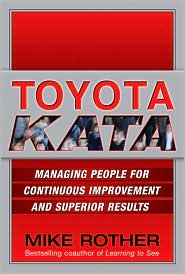


Toyota instills an invaluable mindset in its employees at all levels. When thinking and behavior patterns are repeated over and over in daily work, they become a way of doing something, a method, or routine. In Japan such patterns and routines are called kata. Organized around Toyota’s primary approaches to thinking and acting, Toyota Kata delivers proven patterns—and how to develop them—that can help any manager accelerate a team.

Rother explains how to improve management’s approach through the use of two kata:

 …

Want to continue?
Log in or create a FREE account.
Enter your username or email address
Enter the password that accompanies your username.
By logging in you agree to receive communication from Quality Digest. Privacy Policy.
Create a FREE account
Forgot My Password
Top Stories
All Whys Are Not The Same
AI May Be Making Your Quality Problem Worse
Flying Blind: What Your Quality Data Miss Every Shift
The 6 Best Quality Management Software Features That Simplify Your QMS
Momentum Technologies Achieves Record Purity Milestones for Rare Earths

Add new comment

Please login to comment.

© 2026 Quality Digest. Copyright on content held by Quality Digest or by individual authors. Contact Quality Digest for reprint information.
“Quality Digest" is a trademark owned by Quality Circle Institute Inc.

footer
  • Home
  • Print QD: 1995-2008
  • Print QD: 2008-2009
  • Videos
  • Privacy Policy
  • Write for us
footer second menu
  • Subscribe to Quality Digest
  • About Us
  • Contact Us