{domain:"www.qualitydigest.com",server:"169.47.211.87"} Skip to main content

        
User account menu
Main navigation
  • Topics
    • Customer Care
    • Regulated Industries
    • Research & Tech
    • Quality Improvement Tools
    • People Management
    • Metrology
    • Manufacturing
    • Roadshow
    • QMS & Standards
    • Statistical Methods
    • Resource Management
  • Videos/Webinars
    • All videos
    • Product Demos
    • Webinars
  • Advertise
    • Advertise
    • Submit B2B Press Release
    • Write for us
  • Metrology Hub
  • Training
  • Subscribe
  • Log in
Mobile Menu
  • Home
  • Topics
    • Customer Care
    • Regulated Industries
    • Research & Tech
    • Quality Improvement Tools
    • People Management
    • Metrology
    • Manufacturing
    • Roadshow
    • QMS & Standards
    • Statistical Methods
    • Supply Chain
    • Resource Management
  • Login / Subscribe
  • More...
    • All Features
    • All News
    • All Videos
    • Contact
    • Training

A Primary Standard for Measuring Vacuum

Tracking changes in fluorescence from ultracold atoms is a super-sensitive indicator of pressure

NIST
Thu, 08/18/2022 - 12:02
  • Comment
  • RSS

Social Sharing block

  • Print
Body

A novel, quantum-based vacuum gauge system invented by researchers at the National Institute of Standards and Technology (NIST) has passed its first test to be a true primary standard—that is, intrinsically accurate without the need for calibration.

ADVERTISEMENT

Precision pressure measurement is of urgent interest to semiconductor fabricators that make their chips layer by layer in vacuum chambers operating at or below one hundred-billionth the pressure of air at sea level. They must rigorously control that environment to ensure product quality.


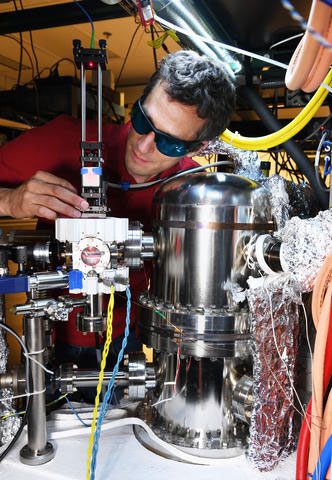
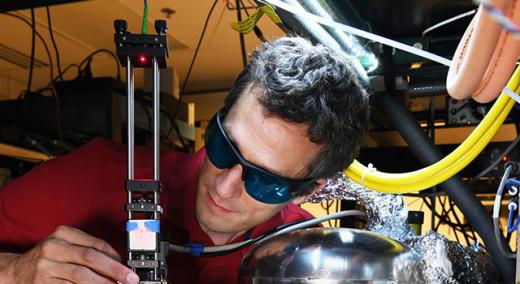
NIST scientist Stephen Eckel behind a pCAVS unit (silver-colored cube left of center) that is connected to a vacuum chamber (cylinder at right). Credit: C. Suplee/NIST

“The next generations of semiconductor manufacturing, quantum technologies, and particle acceleration-type experiments will all require exquisite vacuum and the ability to measure it accurately,” says NIST senior project scientist Stephen Eckel.

 …

Want to continue?
Log in or create a FREE account.
Enter your username or email address
Enter the password that accompanies your username.
By logging in you agree to receive communication from Quality Digest. Privacy Policy.
Create a FREE account
Forgot My Password
Top Stories
Beyond the Statistics: Implementing the New VDA AIAG SPC Manual
Multivariate Charts
All Whys Are Not The Same
Flying Blind: What Your Quality Data Miss Every Shift
Book Preview
The Psychology of AI Adoption at Work

Add new comment

Please login to comment.

© 2026 Quality Digest. Copyright on content held by Quality Digest or by individual authors. Contact Quality Digest for reprint information.
“Quality Digest" is a trademark owned by Quality Circle Institute Inc.

footer
  • Home
  • Print QD: 1995-2008
  • Print QD: 2008-2009
  • Videos
  • Privacy Policy
  • Write for us
footer second menu
  • Subscribe to Quality Digest
  • About Us
  • Contact Us