Inside Quality Insider

Julie Fraser  |  01/04/2012

Julie Fraser’s picture

Bio

Solving the Quality by Design Dilemma

Great theory, tough application

Quality by design (QbD) is a widely discussed approach that is often neither well understood nor effectively executed. Joseph Juran also called QbD “quality planning.” QbD is not primarily focused on typical quality issues such as corrective action, testing, measurement, or monitoring. QbD is a holistic approach to planning to ensure quality is inherent in products and processes.

QbD starts with quality goals, and identifying customers and their true needs. This sets up the target and meaningful goals for the quality program. Meaningful goals are those that customers care about and will thus pay for in your products.

Product and process design drive quality performance. These are clearly shown on the inner ring in the U.S. Food and Drug Administration’s (FDA) QbD graphic in figure 1.
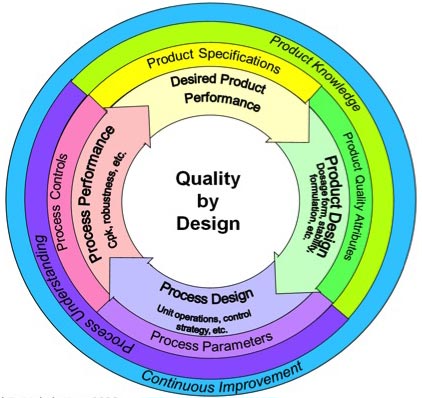

Figure 1: Quality by design (QbD) concept as presented by U.S. Food and Drug Administration (FDA)

Information challenges

The other layers of this model are where many companies struggle to make a success of QbD, largely because the information typically resides in a number of departments, often with separate information systems both automated and manual:
• Product specifications, quality attributes, and design factors may be in engineering, marketing, quality, and customer-oriented systems.
• Process design, parameters, and control are often scattered between research and development, manufacturing engineering, control engineering, chemical engineering, and other groups—and some of the logic is often in individuals’ heads.
• Process performance is something that some industries track closely and others do not at all. Many companies track such key performance indicators in paper systems posted on the wall if they have the information.
• Product knowledge and process understanding are perhaps most scattered of all: Knowledge held by particular individuals must be used to make sense of the scattered bits and pieces that come from every phase of a product’s life cycle and every stage of the supply chain.
• Effective continuous improvement rests on having all of the above organized, and to know how to prioritize the work based on interactions between product and process outcomes. So, although nearly every company has continuous improvement initiatives, the efforts often improve one area only to cause problems in another.

All of this is aggravated because most companies also face an explosion in the number of new products. Figure 2 shows this trend for the medical device industry, but nearly every production segment faces the same challenge. Not only is our information scattered, the volume of products and processes for which we need to track and analyze this information to establish a valuable QbD program is also growing rapidly.


Figure 2: Medical device companies see the innovation rate for new products increasing now, and accelerating in the future.

Cross-functional challenges

This brings us to the topic of product and process correlations. This task is often conducted by Ph.D.s in statistics, who use mathematical models to find correlations and identify risk factors. When these brilliant minds present their findings, others who are not adept at statistics may not be able to grasp the implications—and may feel either intimidated by the math, or bored because they don’t understand the connection to the data they see in their pragmatic daily lives in quality, production, engineering, or design.

Part of the challenge is that the groups use different terminology and information systems. Usually another part of the problem is that much of the real-world data about the products and processes are not readily available for mathematical modeling. As shown in figure 3a, each group has its own system with its own data, and even if the data are available, they may not be normalized for analysis. Because each group has deep expertise in its own area, the mistrust of others and their data can run deep.


Figure 3a: Current departmental information systems with separate data lead to long new product introduction (NPI) cycles and difficulty adopting QbD.

Holistic information approach

For all these reasons, a holistic approach may seem like a distant dream. However, companies can begin to bring the relevant information together to support QbD. In industries such as automotive, electronics, and aerospace, where QbD has been in play for a long time (not always using these terms), companies have turned to product life-cycle management (PLM) as a core system to store product and process data. This approach, as depicted in figure 3b, allows all disciplines to contribute to and draw from a single information repository.


Figure 3b: Product life-cycle management (PLM) uses a common information source to support QbD.

Companies that use PLM are more likely to succeed in continuous improvement across a number of areas, leading to reduced costs and a shorter time to bring about change, as well as improved market success. Figure 4 shows this result for medical device companies, which are highly regulated and relatively recent adopters of PLM.


Figure 4: More companies using PLM improve in areas that matter to nearly any manufacturer’s business success.

The key to success with this PLM approach is to incorporate not only engineering and design information, but also data from every department in the company. Correlating information across the product life cycle, across the supply-chain phases, and among products, processes, and facilities is key to creating full value from QbD. This includes data from marketing, product and process engineering, production, maintenance, quality, and customers and suppliers.

Fortunately, during the past several years the major PLM providers have added the capability to cope not only with CAD data and structured relational data, but also with unstructured data such as that from trials or marketing surveys, social media, and e-mail exchanges with customers and suppliers. Some PLM companies, such as Dassault and Siemens, now offer manufacturing execution system (MES) applications as well, and PTC has two strong MES partners in Apriso and Camstar.

At a pharmaceutical conference on MES, a QbD statistical analyst made a strong case for why data from MES has made his work so much easier and more effective. MES can immediately bring a view of plan vs. actual product and process results. The enormous amount of detailed yet in-context data about the manufacturing results can form the foundation for understanding products, processes and their interactions.

Shifting the mindset

QbD is a is a top initiative for many in the life sciences manufacturing industries, such as pharmaceutical, biotechnology, and medical devices companies. However, much of that is simply because U.S. and European regulators are pushing for it, and setting up pilot programs for QbD submissions. Those companies implementing due to pressure from a regulator may struggle to gain the full benefits.

As with nearly any major transformational change, QbD requires a change in mindset. Companies in FDA-regulated industries historically have had little pressure on their costs and time-to-market. That has changed, and now the pressure to transform is huge. Yet if QbD is viewed primarily as a regulator-driven requirement rather than a business-saving approach, it may fail.

QbD is about planning both the product and the process to ensure quality. As a result, the mindset must shift from corrective actions to preventive actions. When faced with the need to address a corrective and preventive action (CAPA), most companies in life sciences focus on fundamental corrections. Figure 5 shows the focus on standard operating procedures and operator training. In a QbD environment, the first place to look should be product and process designs.


Figure 5: Most companies focus on corrective, not preventive actions today; that changes with QbD in place.

This is a bit “chicken and egg,” since companies that don’t have a consolidated information source as with PLM cannot easily identify the product and process changes required to prevent that problem. We know that PLM cannot be implemented overnight. So there are a few steps that companies can take to move themselves toward QbD as they work on the information infrastructure:
• Create a quality planning process that involves multiple disciplines across the supply chain and the product life cycle—and include those with process knowledge.
• Set the goal of the quality management team to making it impossible to make bad product, rather than complying with regulations.
• Develop daily or weekly work processes or projects, where multiple disciplines participate actively on a single team, particularly in product and process development.
• Characterize and optimize the manufacturing processes.
• Recognize and reward those who foster greater process understanding.
• Involve key suppliers and outsource partners in your efforts because their processes will determine the quality of your products.
• Build out information repositories and analytical systems with greater correlation between products and processes, pulling data from multiple sources.
• Use simulation and verification of design results, and maintain that data as a comparison point for actual results.
• Use existing data to identify best practices, and disseminate that information.
• Visit noncompetitive manufacturers that use QbD, PLM, and MES to understand what is possible, and envision how these approaches and technologies might apply in your environment.


If approached holistically, a QbD approach can deliver enormous benefits. These don’t stop at process and product understanding. They reach into time to market, cost of production, cost of quality, and even into product success. Manufacturers in every segment are now in a competitive situation, and those who embark on a holistic QbD journey soon will be in a better position to win.

Discuss

About The Author

Julie Fraser’s picture

Julie Fraser

Julie Fraser has 25 years experience as a manufacturing systems industry advisor, marketer, speaker, and consultant. An expert on production plant software or manufacturing execution systems (MES), Fraser is the principal industry analyst and the president of U.S. operations for Cambashi, which is a hybrid between a management and marketing consultancy, an industry analyst firm, and a market research company. Prior to Cambashi, Fraser ran the manufacturing applications-focused analyst firm, Industry Directions, and was vice president of marketing for Baan Supply Chain Solutions, senior analyst on MES and integration at AMR, and editor-in-chief of CIM Strategies Inc.’s newsletter.

Comments

Quality Planning Underutilized

Julie has hit on some excellent points.  Quality Planning is one of 3 components of the Juran Trilogy.  Many organizations are investing heavily in Quality Control, and even more so in Quality Improvement, but fail to take the lessons learned and apply to Quality Planning (a.k.a. Quality by Design).  Therefore many products and services are "dead on arrival" because they are not designed to meet the current needs of customers, or the delivery processes are not designed to meet the required capability.  Companies would be wise to re-balance their investment in Quality to address all 3 components of the Juran Trilogy.  Their bottom lines will benefit, and their customers will benefit.

You can create content!

  • Classifieds
  • File Share
  • Forum Topic
  • Events
  • Links

Sign In to get started!

Quality Information