Inside Metrology

Peter Dickin  |  12/07/2005

Peter Dickin’s default image

Bio

New Applications For Machine Tool Probes

New software can help create an accurate simulation of the on-machine verification process.

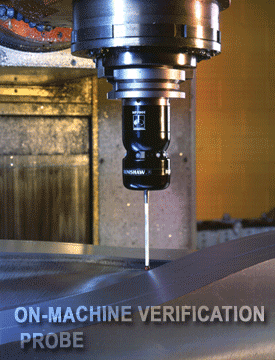
The use of probes on machine tools to assist in setting up jobs is well established. Recent developments in machining and inspection software mean that this equipment can now be used in a wider range of applications that are aimed at increasing overall equipment effectiveness, which consequently improves productivity and profitability. A new application for these probes is on-machine verification. They can be used to collect measurements after a machining operation. Newer software can use data from machine-tool probes in the same way they use data from probes on CMMs. These programs also provide the same benefits as when they’re used on dedicated inspection equipment. They give quick and easy comparison of tooling and sample components against CAD data and produce clear, comprehensive reports that can be understood by everyone involved in the project. As the CAD model becomes the defining reference in product development processes, inspection based on CAD data is steadily replacing measurements based on drawings.

Companies that don’t have inspection capabilities are the most obvious beneficiaries of this approach. There’s some productive time lost on the machine when the measurements are carried out but the ability to program the verification sequences offline, with fully integrated simulation and collision checking, allows for minimal interruption of the machining operations.

In addition, true productivity can only be achieved if good parts are manufactured. When this measure is used, on-machine verification enables the quality of the component to be monitored at all stages in the manufacturing process. This more frequent checking allows any errors to be detected earlier and be corrected more quickly at lower cost. It’s possible to check, for example, that the correct amount of stock has been left on the component after a roughing operation, rather than having to wait until all machining operations have been completed before discovering that an error has been made.

Similarly, the extent of any damage caused by events such as tool breakage can be assessed accurately, making it easier to determine whether the part can still be completed within tolerance or whether it will have to be scrapped. Without such a check, many hours can be wasted working on parts that are already beyond repair.

On-machine verification can also benefit companies with customers that insist on independent inspection of their work. By carrying out an initial verification on the machine, errors that might otherwise not be found until after the component has been shipped to the external inspector, can be detected and corrected,.

Companies already having suitable inspection equipment might think that on-machine verification simply delays the existing machining process. However, on-machine verification can potentially reduce delivery times when taking the entire process into consideration.

For instance, if a part has to be transferred to a dedicated CMM and the inspection shows any errors, the component must be returned to the machine tool and reclamped in position before being machined again. This is time-consuming and can take many hours to inspect in the case of large or heavy items such as aerostructures or press tools for automotive panels. In addition, any additional mistakes when repositioning the part onto the machine tool could result in a new series of errors in the component, which leads to an extra cycle of inspection and remachining.

On-machine verification is also beneficial when machining long runs of smaller parts. In these cases, there may be some delay between parts being manufactured and being measured. Any error that enters the process continues to be duplicated until it’s discovered, resulting in waste of time and materials. More frequent measurements on the machine allow errors to be found earlier and to be corrected more quickly.

However, there’s an inherent problem in allowing a machine tool to check its own work. That’s why the process is referred to as on-machine verification rather than on-machine inspection. No one is suggesting that the machine-tool probe can completely remove the need for independent inspection. It simply gives the ability to find mistakes where they can be corrected—on the machine tool.

Furthermore, on-machine verification allows the part to be checked at each stage. The inspection with specialized measuring equipment only needs to be undertaken once at the end of the manufacturing process. This more regular verification gives greater confidence that the component will be produced within specification and that the time spent producing scrap parts will be minimized.

Machine-tool probes are also being used in adaptive machining. This approach uses a combination of software to give new solutions to a range of challenging manufacturing problems.

The programming of most machining operations is based on knowing three things: the position of the workpiece on the machine, the starting shape of the material to be machined and the final shape that needs to be achieved at the end of the operation. Adaptive machining techniques allow successful machining when at least one of those elements is unknown, by using in-process measurement to close the information gaps in the process chain.

The most common case is where the exact position of the workpiece is unknown. Achieving the correct position and orientation of the part on the machine is a major challenge when machining heavier components, because it takes many hours of checking and adjusting, even when using the latest probing equipment. It’s often easier to adjust the datum for the toolpaths to match the position of the workpiece than it’s to align the part in exactly the specified position. This approach has been used in the machining of geometric features for some time. An equivalent solution for the manufacture of complex surfaces that gives the same benefits of shorter set-up times and improved accuracy is now available in the market.

Delcam’s PowerINSPECT inspection software and PS-Fixture are examples of this new solution. First, a probing sequence is created using the software’s off-line programming capabilities. This sequence is used to collect a series of points from the workpiece, which can be used by a range of best-fit routines to determine its exact position. Any mismatch between the nominal position used in the CAM system to generate the toolpaths and the actual position of the workpiece can be calculated in PS-Fixture. The software can then feed the results to the machine tool control as a datum shift or rotation to compensate for the alignment differences.

The problem of unknown starting shape occurs because of the inherent low accuracy near-net shape forming processes such as casting and forging. This lack of precision means there’s always some uncertainty over the exact starting shape of the component to be machined. The main requirement for efficient machining is to allow an even distribution of material to be removed around the stock to avoid over-machining in some areas and under-machining in others.

This can be achieved by first creating a probing path within the software to determine the exact form of the casting or forging. The model of the final shape to be reached can then be orientated within the CAM system to give an even thickness of material on the surfaces to be machined. Once this has been achieved, toolpaths can be produced as normal. The CAM system must have the capability to generate programs based on an arbitrary starting shape, but this feature is now available in most advanced programs. Other benefits of this approach include the ability to give a smooth transition between machined and unmachined areas, a reduction in air cutting and improved control over the feed rate as the cutter enters and leaves the material.

The most challenging adaptive machining operations are those where the final shape that’s needed in the component is not precisely known. This is most often the case when undertaking repairs to components that have been changed from their nominal CAD shape during service (e.g. turbine blades that have been distorted by the high temperatures in aircraft engines). A similar problem can arise when repairing tools that have been modified after their initial manufacture (e.g. press tools that may have been adjusted to compensate for spring back).

The initial step in these cases is probing the component to determine the extent of its deviation from the nominal CAD data. Then, the morphing functionality in some recent software can be used to bring the CAD model in line with the actual geometry. Finally, toolpaths can be generated for the required areas.

A similar approach can be used when repairing older parts, patterns or tooling for which no CAD data exist. For these components, it’s often only necessary to machine the repaired areas into the surrounding surfaces with a smooth blend, rather than to create a precise region of known geometry.

In all cases, the component can be probed after machining to give a record of the final shape of the part. This data can be used to check the component against a CAD model of the part, or to create a CAD model for future reference if needed.

These examples show ways in which companies can use their existing equipment to increase productivity, and the quality and consistency of their products. For those that haven’t invested in machine-tool probing yet, these new techniques offer powerful arguments for adding the technology. The probes and the supporting software represent a small additional investment when compared to the cost of purchasing a machine tool. With increasing competition, companies must do everything they can to maximize the effectiveness of their machines. Probing technology can help their processes by increasing the number of parts that can be produced from a given machine and by reducing the waste caused when producing defective parts.

Discuss

About The Author

Peter Dickin’s default image

Peter Dickin

Peter Dickin is the public relations manager for Delcam plc, a supplier of advanced CADCAM software. Delcam has offices in England and Canada.