Inside Metrology

Steve Kersen  |  11/09/2005

Steve Kersen’s default image

Bio

Laser Scanning Helps NASA Increase Accuracy of Wind-Tunnel Models

Better and more accurate measurement saves time and money.

Switching from a coordinate measuring machine (CMM) to a laser scanner has helped the National Aeronautics and Space Administration, Langley Research Center, increase the accuracy of models used to evaluate proposed spacecraft designs in wind tunnels. Accuracy is critical for the 6- to 12-in. scale models, because the smallest deviation from the original design could substantially alter performance. It used to take two to three days to measure 30,000 points on the model, which was only enough to define key cross-sections. Recently, NASA has substantially improved this process by measuring the models with a laser scanner that projects laser light onto surfaces while cameras continuously triangulate the changing distance and profile of the laser as it sweeps along.

“With laser scanning, we can capture between four and five million points in four to five hours, substantially reducing the amount of time required for inspection, while at the same time providing enough accuracy to fully define the geometry of most models,” says Ed Covington, quality assurance specialist for NASA’s Langley Research Center. “This provides greater assurance than before that our wind-tunnel test results are accurate, while saving time and money.”

NASA is continually generating concept designs for new spacecraft designed to help the agency further its mandate, in the words of former Administrator Sean O’Keefe, “To pioneer the future, to push the envelope, to do what has never been done before.” One of the first steps in evaluating each of these design concepts is wind-tunnel testing to determine their aerodynamic properties. NASA Langley Research Center represents one of the largest collections of aeronautical research testing capabilities in the world, with 28 separate facilities. The focus of these experimental facilities is to provide low-cost research capabilities for developing an understanding of flow phenomena.

The experiments provide insight into the mechanisms that lead to the observed behavior so that better theoretical predictions and improved models can be developed. The designs are originally created using computer-aided design (CAD) software that creates electronic models. The CAD model is then converted into toolpaths that are used by a computerized numerical control machine to cut out a mold cavity that’s later used to cast ceramic models. In most cases, the geometries are too complicated to fully describe in the CAD model, so hand work is necessary to bring them to their final shape. This creates the possibility of human error. Another possible cause of errors is that the ceramic part may warp in the cooling process. Even very small deviations can have a major effect on wind-tunnel results in scale models of this size.

Capturing cross-sections with CMMs
In the past, CMMs were the primary tool used to measure the models. CMMs can measure individual points to a high level of accuracy and can be programmed to move from a sample location to a location under computer control. However, this approach limits the number of points that can be acquired and usually makes it impossible to fully define the contours of complicated components. In three days, an experienced NASA technician can typically capture about 30,000 points, providing a considerable amount of detail, but it’s still not enough to unambiguously describe the most complicated spacecraft designs. Another disadvantage of the CMM is that the probe must touch the model for each measurement. This makes it impossible to measure internal features smaller than the probe and raises the risk of damaging models made of softer materials.

NASA engineers evaluated various alternatives for improving the measurement process. They tried an optical digitizing system, but it didn’t provide as great a speed improvement as they were looking for. This also made it necessary to spray the model with white paint and perform all measurements in the dark.

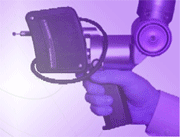
On the other hand, they felt that laser scanning technology provided great potential improvements. To record the shape of a spacecraft model, the technician simply holds the laser sensor so that a line of laser light appears on the body. Laser-stripe sensors project a laser onto the object, while a small CCD camera views the line as it appears on the surface. As the technician moves the sensor over the surface of the body, a dedicated interface card translates the video image of the line into 3-D coordinates. Real-time rendering of the data gives immediate feedback. This is important because it lets the technician see areas that were missed. The system combines the coordinate data with the Cartesian and angular coordinates generated at each position of the mechanical arm. The result is a dense cloud of 3-D data describing the surface of the object. When the scanning is finished, the point-cloud data is converted into a surface model of the component. Special software then compares the original design geometry to the completed part, generating an overall error plot that allows a view of global deformations and problem areas.

NASA purchased NVision Inc.’s ModelMaker laser scanner, a system that can be easily configured to work with several of the commercially available position-sensing mechanisms. NASA chose a portable CMM, with a seven-degree-of-freedom portable multi-axis measurement arm, that can be used to easily capture individual point measurements. “The key advantage of combining the two is that the laser scanner can be used to capture broad areas of the geometry, while the digitizer can be used for point measurements such as holes or bosses,” Covington says. “We especially like the fact that we can switch from the digitizing mode to the laser scanner mode without having to disassemble the scanner from the digitizer arm. In addition, NVision’s technical support, both during and after installation, has been very good.”

The ModelMaker scanner is 100-percent synchronized to the arm through a cable connected to the interface box. It provides multiple power settings to scan black and dark colors without any coating. Data can be exported in multiple formats including IGES, STL, DXF, VDA, IBL, ASCII and several others that are readable into all CAD or inspection software.

Defining full contours with laser scanner
NASA technicians now scan each scale model with the laser scanner prior to wind-tunnel testing. While in the past they were only able to capture key cross-sections, now they can easily generate the entire contour. They import the resulting point cloud into ImageWare software, which converts the point cloud into a surface model. ImageWare automatically compares the original design to the as-built model and generates a color-coded chart that shows exactly how much the collected data points deviate from the CAD model. This process is called registration and it superimposes the point-cloud from the scanned data onto the CAD surface model. For example, points below the surface of the model might be shown in blue while those above the surface would be shown in red. The user may also opt to show all the points outside the client’s tolerance settings in a single color.

Statistical information such as the percentage of points out of tolerance and the standard deviation is also provided. In most cases, engineers are most interested in comparing the roll, pitch and yaw of the model in relation to the balance, which is used to hold the model in position. Errors in the model that are revealed during the scanning process can usually be compensated for by changing the sting to provide the proper offsets.

“Laser scanning has provided substantial improvements over our old methods,” Covington concludes. “We have maintained the high accuracy of our model-acquisition data, while generating 100 times more data points, plus decreasing the time required for the inspection process, making it easier to meet and maintain the wind-tunnel schedule. Since we have been using the laser scanner, the job of validating the accuracy of our wind-tunnel models has been transformed into a more efficient routine.”

Discuss

About The Author

Steve Kersen’s default image

Steve Kersen

Steve Kersen is the vice president of sales and marketing for NVision Inc. He was part of the group that started NVision, Inc. in 1990 and has aided the company in its growth over the past 15 years by helping it expand beyond a scanning service company to include sales of noncontact laser systems, portable CMMs, reverse engineering and inspection software, and a consulting division. Kersen holds a chemical engineering degree from the University of Texas and worked for ExxonMobil prior to starting NVision.