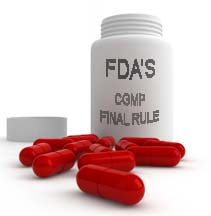
In June 2007, the U.S. Food and Drug Administration issued the dietary supplement current good manufacturing practice (cGMP) final rule (21 CFR Part 111). In essence, the final rule requires that the proper controls be in place for dietary supplements during manufacturing, packaging, labeling, and holding operations.
Purpose of the cGMP final rule
The purpose of the cGMP final rule is to establish quality standards for dietary supplements. Until recently, the Food and Drug Administration has tended to view itself as filling more of a watchdog role as far as dietary supplements are concerned, with the FDA’s MedWatch consumer complaints hotline serving as the alert system.
This watchdog role led to the voluntary recall of the dietary supplement Nasutra in September 2006, after it was discovered that the dietary supplement contained an analogue of sildenafil (acetildenafil), the active pharmaceutical ingredient in Viagra.
According the FDA press release announcing the recall, “Acetildenafil is an analogue of sildenafil. Sildenafil is the active pharmaceutical ingredient in Viagra, an FDA-approved drug that is used to treat erectile dysfunction (ED). Acetildenafil is close in structure to sildenafil and is expected to possess a similar pharmacological and adverse event profile.”
By imposing quality standards, the new ruling will also protect consumers against supplement manufacturers who misrepresent the quantity of a product’s active ingredient, or don’t disclose everything about their product’s ingredients. The recall of FiberChoice’s multivitamin, for example, was initiated after it was discovered that the product contained fish gelatin, a known allergen, which was not disclosed on the product label.
Moreover, the final rule provides the following consumer benefits:
The FDA points out that the ruling addresses only the quality of the manufacturing processes for dietary supplements and the accurate listing of supplement ingredients. It doesn’t limit consumers’ access to dietary supplements; nor does it address the safety of the dietary supplement’s ingredients, or their effects on health, when proper manufacturing techniques are used.
Nonetheless, cases such as Nastura, in which a previously unknown ingredient (acetildenafil) resulted in potential harm to a group of consumers, obviously would be included under the purview of the FDA’s final rule. It’s interesting to note that, according to the Taiwan Department of Health, acetildenafil appeared to be an instance of an ingredient being illegally adulterated into the dietary supplement.
Companies Affected by the Final Rule
The provisions in the cGMP final rule (FDA 21 CFR Part 111) apply to manufacturers of nonprescription dietary supplements intended for human use. Dietary supplements are a subcategory of nutraceuticals. The latter include a broad category of nutritional products ranging from isolated nutrients and dietary supplements, to genetic engineering products such as broccoflower (a hybrid produced by crossing broccoli and cauliflower). According to the FDA, the dietary supplements affected by the final rule include:
The FDA’s cGMP requirements apply to all domestic and foreign companies that manufacture, package, label, or hold dietary supplements, including those involved with testing, quality control, and dietary supplement distribution in the United States.
Specific requirements of the final rule
In addition to requirements having to do with equipment, cleanliness of the facilities and related matters, the final rule requires manufacturers of dietary supplements to:
Staggered three-year phase-in to limit disruption to small businesses, the cGMP final rule stipulates a staggered three-year phase-in according to the following schedule:
Challenges of establishing and maintaining compliance, and how automated solutions can help
Many manufacturers of dietary supplements may face significant challenges in complying with the FDA’s final rule. Under the final rule, for example, written procedures must be established for quality control operations. These written procedures must include the steps to be followed when conducting a material review and making a disposition decision.
The final rule requires that quality control personnel conduct the material review and make a decision regarding disposition when, for example, a batch of product deviates from its master manufacturing record, or an unanticipated event occurs during a manufacturing operation that leads to the adulteration of any portion of a dietary supplement (including its packaging). Quality control personnel are also required to conduct a material review and make a disposition decision if there’s a problem with the equipment or how the equipment is calibrated.
Without a centralized, document control, and management solution, it can be difficult to establish (and maintain) written procedures for quality control operations. This is because, with a manual system—as well as a decentralized, hybrid system—it’s difficult to ensure that employees are using the most current and up-to-date version of a document. As a result, there is no guarantee that a given procedure for a quality control operation is the most current, up-to-date version. This can result in confusion, inefficiencies, and poor quality control.
How an automated document control/management solution can help:
Automated solutions can help in other areas by effectively handling deviations and nonconformances (i.e., unanticipated occurrences) during the manufacturing process; by helping calibrate and inspect equipment; by making sure that all employees and supervisors are qualified to perform their job functions; by handling customer complaints; etc.
In summary, an automated document control/management system and automated processes can help assure quality, regulatory compliance, proper documentation, and greatly speed up all required FDA current good manufacturing processes involved in the production of dietary supplements.
Sign In to get started!