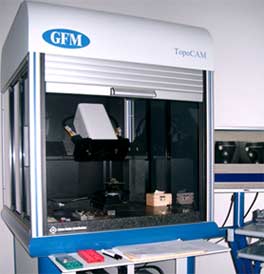
Coordinate measuring machines (CMMs) are a basic requirement for any industrial manufacturing facility conforming to the specifications of drawings and standards. Accuracy needs to be observed, verified, and certified with respect to a comprehensive set of standardization rules. Highly precise CMMs have costly requirements such as vibration isolation, environmental temperature stabilization, and a long measurement time. An ideal CMM would function without these drawbacks so that the same measuring performance could be taken directly to the production line and used by manufacturing personnel. These shortcomings don’t have any foreseeable solutions in the near future. However, there’s economic motivation to demand an easy-to-use CMM without the requirements of environment control and long measurement times for the acquisition of accurate 3-D data. CAD-based manufacturing takes its measures and tolerances from CAD data. A 3-D measuring device that could, within a few minutes, provide several million measuring points and compare that data to CAD data as a nominal/actual value comparison by manufacturing personnel on site would meet the demands of industry.
Fringe projection as an optical 3-D measurement technique
Fringe projection as an optical measurement technique combines the advantages of triangulation techniques and the real-time interferometry. With these two techniques, large objects with rough surfaces can be quickly and accurately measured. This is possible because the fringe projection works by projecting a sequence of equidistant fringe projection patterns with a nearly cos²-shaped intensity distribution on the scanned surface as compared to the triangulation technique, which projects a single point of light or a light-section. Two cameras, angled to the direction of the projection, observe these fringe projection patterns. Figure 1 shows the functional basics of such a fringe projection measurement setup. The 3-D measurements result from the deflection of the projected parallel fringe pattern on the curved surface as inspected by the two cameras due to triangulation. The projected fringe patterns are, as mentioned before, nearly cos²-shaped, and thus they can be perceived as interferograms; they can be evaluated by algorithms for phase analysis, just as they are used for real-time interferometry techniques. This phase measuring fringe projection technique enables a much higher resolution of the profile and accuracy of the measurement. Fringe projection also allows 3-D measurements without moving the target object or the sensor, as conventional triangulation measurement techniques would require.
![]() |
|---|
Figure 1: Principle of a fringe projection setup including two cameras and a projector |
A fast projection of the fringe pattern is essential for a precise measurement and a good use of the fringe projection, which requires an intensity distribution as much like the distribution of wave-optically generated interferograms as possible. Both of these requirements are supported by the use of micro-mirror displays, as developed using DLP technology by Texas Instruments, and globally used for light projection in diverse applications³. Texas Instrument’s micro-mirror projectors facilitate high contrast and strong light, and they feature separately and digitally controlled mirrors with a maximum size of 1024 x 768 pixels. This makes it possible to measure black as well as partially reflective surfaces such as tools of precision forged gearwheels, as shown in the following examples of use.
The subject of evaluation when employing the fringe projection technique is the registration and evaluation of the fringe patterns and their distribution, which result from the position of the cameras and the intersection of the fringes, projected in parallels, and the curved surface. These fringe patterns represent a direct 3-D image of the surface, and the degree of deflection and the density of the fringe distribution respectively allow for a qualitative evaluation of the surface shape of the measurement object.
Fringe projection-based coordinate measurement technique
CMMs in the industrial production are an indispensable tool for quality assurance of the produced parts, which conforms to the given standards. Tactile CMMs are now common and are mainly used in special measuring laboratories. Optical and tactile systems are combined to form so called multisensor CMMs. They’re either equipped with point- and/or line-based laser scanning systems or autofocus sensors.
Within a few seconds, fringe projection CMMs supply plane 3-D datasets with up to several million single-measurement points. The part to be measured can be scanned from several directions, with each scan resulting in a so-called single view. These single views are merged using software to obtain a complete 3-D dataset of the measured part. This 3-D dataset can be used for a 3-D measurement as well as a CAD-based nominal/actual value comparison using the appropriate measuring and evaluation software.
Optical 3-D coordinate measurement machine
An optical measurement machine is a fringe projection-based CMM, which, as seen in figure 1, has a projector and two sideward-oriented CCD cameras. The photograph at the top of this article shows the design of the TopoCAM measurement machine. The standard version of this measurement machine carries at least three CNC linear axes, which can move the 3-D sensor and/or the measured part in the x, y, and z directions. If required, it’s possible to install a measuring panning or rotation axis in addition to the linear axis. The part to be measured is placed in a simple and normally universal adapter. At the push of a button a specific measurement program starts, which controls the measurement, the necessary movements of the axis, and the assembly of the single scatter plots or single views to form a complete 3-D scatter plot. The result of the measurement will include a 3-D dataset and a complete solid of the measured part respectively, and if need be it will directly, without manual intervention, conduct a comparison with the related CAD model.
The time requirement for the measurement of more than two million measurement points and the output of the measurement and the test result based on the mentioned nominal/actual value comparison adds up to less than one minute. Due to the robustness of the measurement system and its simple handling, these measurements can be conducted on site during the production process and directly by the production personnel. There’s no need for special knowledge about measurement techniques, in particular regarding the handling of optical 3-D measurement systems. The required accuracy of the measurement can be adjusted according to the current constructive necessities. Basically the relation of the accuracy of the optical measurement system and the component tolerance at hand is 1/10.
Software
In many cases, and especially when dealing with dimension controls in industrial production, a nominal/actual value comparison of the 3-D dataset, or the solid and the related CAD dataset, or a master dataset, might be sufficient for a “good/bad” evaluation of a produced part. Figure 2 gives an example of such a contour control of a turbine vane, showing a so-called differential image of the measured turbine vane and its CAD model. The colors indicate the extent of the form deviation, which can also be numerically displayed in a table.
![]() |
|---|
Figure 2: CAD-based nominal/actual value comparison of a turbine vane |
On the one hand, the comparison of the CAD dataset and the optically measured 3-D dataset as shown in figure 2 isn’t sufficient for a complex 3-D coordinate measurement as usually conducted when using common CMMs. On the other hand, the currently available software packages, for example, the Calypso package which is distributed by Carl Zeiss, aren’t designed for the need of optical 3-D measurement techniques and aren’t able to cope with the efficient evaluation of 3-D datasets containing several millions of single measurement points.
The numerical evaluation of scanned contours or surfaces is basically limited to regular geometric characteristics such as cylinders, planes, straight lines, spheres, and circles. However, modern production techniques more and more support creative design, which is no longer bound to regular shapes.
To process 3-D datasets containing several millions of measurement points for the purpose of the 3-D coordinate measurement technique, the GFM developed the software package TopoXenios, which supports the recording of the measurement as well as the extensive evaluation, including:
At the same time, TopoXenios enables the automation of the complete measurement routine, from the measurement data acquisition to the evaluation and, if necessary, a CAD-based actual/nominal value comparison; this is of high importance for the use in production and in production-related areas, respectively.
Calibration and accuracy of measurement
When calibrating the measurement volume of a fringe projection CMM, a specially designed calibration strategy and specifically certified calibration probes for the x and y planes, as well as for the z direction are used. In addition to the calibration of the measurement volume, it’s necessary to adjust to existing deviations of the optical projection and recording equipment and to state these corrections of the evaluation program in a so-called correction matrix5.
The certification of a proper calibration state of the fringe projection CMM is conducted in accordance with the VDI/VDE guideline 2634, which was developed especially for planar optical CMMs¹. Afterwards, as shown in figure 3, a barbell-formed specimen is placed on defined measurement positions of the sensor’s measurement volume and each distance to the sphere of the barbell is determined. The size of the barbell respective of the diameter of the sphere depends on the underlying measurement volume of the sensor and is defined in the cited guideline.
![]() |
|---|
Figure 3: Control of the calibration state of a planar optical CMM according to VDI/VDE 26341 |
Figure 4 shows the barbell according to VDI/VDE 2634 for the TopoCAM measurement volume of the size 40 mm x 30 mm x 30 mm, as it’s used for certifying the proper calibration state for this kind of measurement machine. Figure 5 displays a barbell composed from six single views. Table 1 summarizes the results of ten single measurements of the barbell on the measurement volume.
![]() |
|---|
Figure 4: Measurement probe according to the standard VDI/VDE-26341 |
![]() |
|---|
Figure 5: 3-D scatter plot of the measurement probe |
Single measurement |
1
|
2
|
3
|
4
|
5
|
6
|
7
|
8
|
9
|
10
|
x
|
Measurements [μm]
|
16,7985
|
16,7960
|
16,7937
|
16,7946
|
16,7953
|
16,7950
|
16,7960
|
16,7940
|
16,7955
|
16,795
|
0
|
| Table 1: Results of the measurement of the probe according to VDI/VDE 2634 (calibrated radius: 16.795 μm) | |||||||||||
These results indicate an accuracy of measurement of 2.5 μm + L/100, which is a satisfying value for a planar tactile optical CMM. Thus the use of this fringe projection CMM is guaranteed regarding essential technical applications.
Measurement of an insert
The manufacturing accuracy of cutting inserts, like all other cutting tools, must adhere to strict dimensional requirements. Dimensional requirements have to be assured during the manufacturing process as well as during practical use. Currently, either mechanical, tactile, or optical measurement techniques are used for the measurement of tools and cutting inserts. Normally these measurement techniques generate single-point measurements or profiles. A new concept for the total 3-D measurement of tools and inserts is the use of TopoCAM in combination with the software package TopoXenios. This new concept is based on the approach of measuring several single views of the whole tool or cutting insert and subsequently evaluating the dimensions or conducting a nominal/actual value comparison by the use of the software package TopoXenios.
Geometry scan
A version of TopoCAM with a 40 mm x 30 mm x 30 mm sized measurement volume is used for the geometry scan of the cutting insert. The parameters indicate an accuracy of measurement of 0.0025 + L/100 for this measurement volume, which is equal to the accuracy of a mechanical tactile CMM and which is adequate for this function.
During the measurement procedure, the cutting insert is positioned on a precision table inside the measurement volume of the TopoCAM. A computer controls the measurement table so individual measurement positions may be viewed. At each position, a 3-D scatter plot of the currently visible area of the cutting insert is recorded. After recording, the single plots are automatically combined to form a complete scatter plot or a solid volume model, which can then be used for the future analysis of the measurement. Figure 6 represents the graphic resulting from the described measurement process. The upper part of the figure shows the combined 3-D scatter plot, the lower part displays four single views. The software is used for scanning the 3-D scatter plot or solid of the cutting insert, shown in the upper section, and then allows for a CAD nominal/actual value comparison. The software provides the data for further evaluations as shown in figure 7. The displayed data already contains the coordinate system of the cutting insert as determined by the software program.
![]() |
|---|
Figure 6: 3-D measurement data scan (3D-Messdatenaufnahme) of a cutting insert using TopoCAM |
![]() |
|---|
Figure 7: Optically measured 3-D data of an insert |
Evaluation
The metrological evaluation of the measured cutting insert, as seen in figure 7, can be supported by several tools of the TopoXenios software package. These tools either assist in the measurement, allow the direct dimensioning of the 3-D scatter plot, or the dimensioning of defined section planes, which can then be extracted in form of graph lines and can be used for measuring the graph. This procedure is displayed in figure 8 and figure 9. The section plane, as seen in figure 8, refers to a given plane. The section plane is then redisplayed as a single plane with dimensions, which are generated using the dimensioning tool, as seen in figure 9. In this way, the dimensions of measured 3-D profiles of a tool or a cutting insert can be determined and numerous single planar sketches can be generated.
![]() |
|---|
Figure 8: Selection of section planes for dimensioning |
![]() |
|---|
Figure 9: Dimensioning the extracted section |
As the optical 3-D measurement machine generates a complete 3-D scatter plot or a solid of the cutting insert, it lends itself to directly measure the 3-D scatter plot and thus conduct a 3-D evaluation. Figure 10 represents this new possibility for a 3-D evaluation on the measured cutting insert as it’s made possible by the software. Compared to the common 3-D coordinate measurement techniques, which support this evaluation method in a similar way, the fringe projection optical 3-D coordinate measurement technique makes it possible to record several hundred measurement points and several million measurement points. Thus, the measurement accuracy as well as the measurement possibilities significantly increase and at the same time make the measurement easier to handle.
![]() |
|---|
Figure 10: 3-D dimensioning of the measured solid of an insert |
Gearwheel measurements
For a fast and areal acquisition of the whole geometry of the gearing of precision-forged gear-wheels, comprehensive measurement and evaluation strategies where developed on the basis of the fringe projection technique. As a result of the optical and areal measurements, an analysis of the whole gearwheel geometry is made possible for the first time. In addition, the measuring time is reduced dramatically, compared to conventional tactile gearwheel measurements.
To reliably control a process chain for the manufacturing of precision-forged high-performance gearwheels, a production-related inspection of the intermediates before the hard finishing is essential. The analysis of the geometric data provides information about the characteristics of the deviations and supplies the actual data for process control. In this way, it’s possible to detect wear of the forming die or geometric errors caused by the heat treatment. To eliminate the cause of these systematic deviations, adapted process parameters can be passed on to the corresponding subprocesses.
Data acquisition
Due to the geometric properties of the gearing and the use of preferably small measuring fields5, the acquisition of the work piece geometry is carried out with respect to the pitch angle. A number of datasets were acquired, according to the number of teeth, where the gearwheel is rotated about the pitch angle between two acquisitions. By this approach many parts of the geometry are recorded redundantly6. Hence, areas with high slope, which cause large measuring inaccuracies, can be eliminated from the single measurements, because the neighboring images contain these areas under better optical conditions. Through this technique, it’s possible to optimize the amount of data and the measuring time.
The recombination of the complete geometry is carried out only by means of geometric transformations of the measuring points. Neither complex matching operations nor registration processes are accomplished. This approach demands a most accurate determination of the rotating axis, which lies outside of the measuring volume. The rotating axis is determined by measurements on a reference cylinder, whose diameter equals the pitch circle diameter of the measured gearwheel7. The rotating axis is used as the preliminary gearing axis.
Figure 11 demonstrates the recombination of the complete geometry. After the processing of the raw data, the number of measuring points is reduced to approximately 2.1 x 10⁵ per single measurement. The complete geometry of the gearing (approx. 8 x 10⁶ points) is recombined through rotation and translation of the single datasets, with respect to a preliminary work piece coordinate system, which is oriented on the rotating axis.
![]() |
|---|
Figure 11: Recombination of the complete geometry from single measurements |
Evaluation of the gearing deviations
Of particular interest in the testing of the precision forged gearwheels is a quick visual assessment of the functional surfaces. First, the functional surfaces are extracted from the measuring datasets and fitted on a reference involute. Then, the deviations of the measuring points are calculated orthogonally to the reference. The color-coded results of the optical measurements can be presented very clearly on a 3-D model of the tested gearwheel, which can be freely moved and turned in all dimensions.
This kind of illustration allows for a first qualitative evaluation of the gearing deviations. In addition, it’s possible to acquire information about the tooth width and pitch deviations indirectly by evaluation of the absolute deviations.
![]() |
|---|
Figure 12: Illustration of the deviations on the tooth flanks on a geometric model of the tested gearwheel |
A quantitative analysis of the geometric errors, aiming at an objective evaluation, a determination of tolerances and the analysis of manufacturing errors, can be carried out by means of areal parameters, which are partially based on conventional line based gearwheel parameters7. As an example, figure 13 shows the definition of the areal parameter FΣ, the total deviation at the gearwheel flank. The characterization of the geometric data using areal parameters supplies information about the characteristics of the deviations and supplies the actual data for process control.
![]() |
|---|
Figure 13: Definition of the areal parameter FΣ, the total deviation at the gearwheel flank. |
Summary
This article introduces the basics and the metrological application of a novel method for optical 3-D measurements. The method is based on the phase measuring digital fringe projection technique. As previously shown, it is possible to construct measurement machines that implement the fringe projection measurement technique. These optical 3-D CMMs, when equipped with the appropriate measurement volume, provide a measurement accuracy comparable to conventional mechanical tactile measurement machines. This novel type of measuring machine offers the specific advantage of measuring several million measurement points on a tool, component, or cutting insert within a very short time period. The large amount of measurement points allows excellent detection of details on the profile of the part. Furthermore, it was shown that the use of the software package TopoXenios enables the processing of these measured 3-D datasets that contain several million single measurement points. Thus, it’s possible to extract standardized geometries from the measured 3-D dataset based on form, dimension, and position. CAD-based nominal/actual value comparisons of the measured tool or component can be conducted as well. The given examples of use, measuring and evaluating a cutting insert and a precision forged gearwheel demonstrate just two of the many applications of this innovative measurement technique.
References
1VDI/VDE-Guideline: “Optical 3-D measuring systems—Optical systems based on area scanning,” VDI/VDE-2634, 2003.
2Frankowski, G., “Optische 3-D-Messtechnik für Forschung und Produktion mit digitaler Mikro-Mikrospiegelspiegel-Streifenprojektion,” Internationales Kooperationssymposium “Qualitätssicherung durch Meßtechnik und Bildverarbeitung,” Steyr/Österreich, September 28 and 29, 1999.
3Hornbeck, L.J., “Digital Light Processing and MEMS: Timely Convergence for Bright Future,” Micromachining and Micro Fabrication ´95, Austin, Texas, 1995.
4Frankowski, G.; et al., “Real-time 3-D Shape Measurement with Digital Stripe Projection by Texas Instruments Micro mirror Devices DMD,” SPIE-Proc., 3958, pp. 90-105, 2000.
5Koch, A.; Ruprecht, M.; Toedtler, O., and Haeusler, G., “Optische Messtechnik an technischen Oberflächen,” Expert Verlag, 1998.
6Kaestner, M.; Meeß, K.; Seewig, J.; Reithmeier, E., “Optische Geometrieerfassung von Zahnrädern,” Verzahnungsmesstechnik, Stuttgart, June 14 and 15, 2005.
7Meeß, K., “Flächenhafte Messung optisch kooperativer Stirnräder am Beispiel präzisionsgeschmiedeter Verzahnungen,” Dissertation, Universität Hannover, 2005.
Sign In to get started!