
|
|
SPC Guide |
|
|
|
|
A problem often develops when students attempt to apply statistical process control theories in a production environment. Operators, and even supervisors, can be hostile. Data may be hard to get. If there is data, there may be too little to compute reliable control limits. Processes can seem so complex that they intimidate. After an SPC training session, one of my students asked, "I understand the theory, but exactly what do I do?" During the course I had told him to do the following:
Although he was eager to learn, he didn't know how to proceed. I told the student to find me a team that was collecting dimensional data. He took me to the next meeting of a group studying the production of ceramic plates used as electronic substrates. Their customer had told them the most important aspect of their process was thickness control. The operator was already keeping records of thickness readings, so I made a histogram of the data. It did not appear to be normally distributed. I plotted an x bar and r chart of the data. On this chart, the horizontal axis represents time, with the parts listed in the order of manufacture. The vertical axis is the thickness of the part measured in thousandths of an inch (0.001"). Several points were outside the control limits as shown in Figure 1.
I took a look at the production process. As I watched, I noticed that the operator constantly made adjustments. I asked the operator to stop making adjustments. She politely informed me that if she stopped making adjustments, the parts would go out of specification. Even the area supervisor was unwilling to run the process without adjustment. This is where theory gets into trouble. Even though the control charts indicated something was wrong, no one wanted to listen. I had to go all the way to the plant manager to get results. He had a special run of parts made for engineering. These parts didn't have to meet specification. It took several weeks to work the engineering run into the production schedule. Even then, I had to stand by the machine and watch to keep the operator from making adjustments. The analysis of the engineering parts showed all the points to be in control. In fact, the team said that these were some of the best parts they'd ever seen. During the next few months, the team improved the process in several ways. During the course of this study, process variation was reduced from ± 0.0035" to ±0.0007". Figure 2 shows the final results. The analysis in this study was straightforward. The difficulty was in getting the production people to cooperate. It isn't enough to simply analyze the data; people must take action on the results. Experience made me persist. As a result of determination, the customer was delighted, the team was satisfied, and my student had a new understanding of how to apply SPC. About the author Gregory P. Ferguson is quality manager of Parker Hannifin's Tucson facility. He has published technical articles and assisted in the publication of two books. Comments can be e-mailed to him at gferguson@qualitydigest.com . |
|
| [QD Online] [Software] [Books] [First Word] [Applications] [SPC] |
|
|



 Determine which variable to monitor.
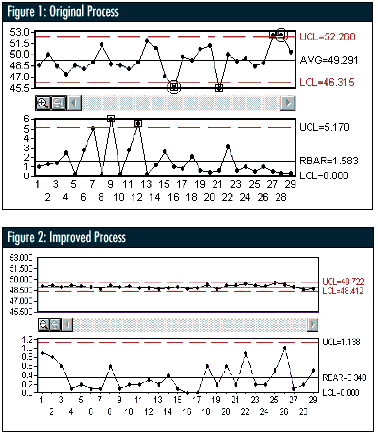 In particular, the range chart was out of control. This is bad. If the range chart is out of control, it means that two parts made during a relatively short time differ significantly.