
|
|
SPC Guide |
|
|
|
 |
|
When you study a production process, or anything in life for that matter, it's wise to use a careful and methodical approach. As Joseph M. Juran says: "It isn't what you don't know that hurts you; it's what you know for sure that isn't so." It's important to verify all facts, check out all assumptions and triple check every important aspect of a problem. Juran solves problems as if he were walking through a dark tunnel littered with rubble: He moves slowly and carefully to avoid tripping over unseen obstacles. Many people have a different perspective; they approach problems as if they were running through an open meadow in bright sunlight. Figure 1: How Many Squares? I once worked with a team trying to eliminate cracks in their parts. When I started, the team told me that cracks never occur at a certain stage in the production process. Telling me that was like waving a red flag in my face--I wondered if it was really true. I decided to find out. I ran a simple experiment and found many cracks much earlier in the process than anyone had thought possible, so at first no one would believe me. I learned not only that the cracks occur earlier than people thought, but also that all the cracks were in the same place on the parts. I had only been on the job a few weeks and no one wanted to believe the "new guy" could discover something they had been ignoring for years. However, through my experimentation, I had discovered a fact. And, as one of my very wise engineering professors liked to say, "One fact is worth a thousand opinions." Organizations develop mythologies. People accept the popular myths because it seems easier and safer to do so. I try to verify everything because I know my efforts won't cost me much if I'm wrong. Of course, many of the things I check turn out to be just as people said they would be--but every once in a while, I find a real gem. Let's move through the problem of Figure 1 slowly and carefully, as if we're in a dark tunnel. Start with a definition. What is a square? A square is a four-sided polygon with sides of equal length and with right angles in the corners. Consider Figure 1 again. According to our definition, there are 16 small squares. And the entire object is a square, that's how we got to 17. But what about squares 1, 2, 5 and 6? Don't they form a square as well? And, of course, 3, 4, 7 and 8; 9, 10, 13 and 14; and 11, 12, 15 and 16 also form squares. So now we see 21 squares. Eventually the crack team understood that there were different kinds of cracks, that these cracks occurred at several stages in the process and were caused by different factors. The team went on to produce millions of parts without finding a single crack. That's not quite the same as saying they didn't produce any cracks--they just didn't find any. Nonetheless, their defect rate had been reduced to a few parts per million. Now take an even closer look at Figure 1. What about 1, 2, 3, 5, 6, 7, 9, 10 and 11? Isn't that a square by our definition? Also consider 2, 3, 4, 6, 7, 8, 10, 11 and 12; 5, 6, 7, 9, 10, 11, 13, 14 and 15; and 6, 7, 8, 10, 11, 12, 14, 15 and 16. Now we can see 25 squares of four different sizes. Some problems take a great deal of time to discover and resolve. For example, the crack team had worked unsuccessfully for years to push their defect rate below the detection level. Once they discovered the many causes of the problem, they were finally able to reduce cracking to an acceptable level. Some problems are tolerated for years before some dedicated individual takes them on and solves them. In the case of Figure 1, a hasty glance reveals 16 squares. As you keep after it, more and more are revealed. Returning to Figure 1, if 1, 2, 5 and 6 make a square, then what about 2, 3, 6 and 7? Also consider 7, 8, 11 and 12; 10, 11, 14 and 15; and 5, 6, 9 and 10. Finally consider 6, 7, 10 and 11. That adds five more to make a total of 30 squares. A casual observer, a meadow-thinker, could look at Figure 1 and see only 16 squares. But a careful observer, working slowly through the problem, can find almost twice that many. Do you think there are 30 squares in Figure 1? Not me. I'm still with Juran in a dark tunnel, carefully looking for more squares.
About the author Gregory P. Ferguson is quality manager of Parker Hannifin's Tucson, Arizona, facility. He has published several technical articles and assisted in the publication of two books. Comments can be e-mailed to him at gferguson@qualitydigest.com . |
|
| [QD Online] [Software] [Books] [Applications] [SPC] |
|
|
|


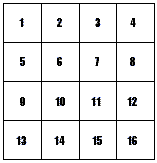 Consider Figure 1. How many squares are there? Did you say 16? You're approaching the problem as if you're in a meadow. Look again. Now do you say 17? That's better, but it still isn't enough.