Inside Quality Insider

Georgia Institute of Technology  |  02/17/2012

Georgia Institute of Technology’s picture

Bio

Model Analyzes Shape-Memory Alloys

For earthquake-resistant building and bridge design and retrofit applications

Recent earthquake damage has exposed the vulnerability of existing structures to strong ground movement. At the Georgia Institute of Technology, researchers are analyzing shape-memory alloys for their potential use in constructing seismic-resistant structures.

“Shape-memory alloys exhibit unique characteristics that you would want for earthquake-resistant building and bridge design and retrofit applications,” says Reginald DesRoches, a professor in the School of Civil and Environmental Engineering at Georgia Tech. They have the ability to dissipate significant energy without significant degradation or permanent deformation,” says Reginald DesRoches, a professor in the School of Civil and Environmental Engineering at Georgia Tech.
https://lh6.googleusercontent.com/JldMfym4QyAJI_5Z7MaUWZTrPV7dm6f5vOdkT4Fxzx7buwyNhql9eu-uJcCjxRO2GfNPiMJNdw8Osdavql5IjMWX-2UcBQeUNCWEE6R-aFe5FbULdMs

Georgia Tech researchers have developed a model that combines thermodynamics and mechanical equations to assess what happens when shape-memory alloys are subjected to loading from strong motion. The researchers are using the model to analyze how shape-memory alloys in a variety of components—cables, bars, plates and helical springs—respond to different loading conditions. From that information, they can determine the optimal characteristics of the material for earthquake applications.

The model was developed by DesRoches, School of Mechanical Engineering graduate student Reza Mirzaeifar, School of Civil and Environmental Engineering associate professor Arash Yavari, and School of Mechanical Engineering and School of Materials Science and Engineering professor Ken Gall.

A paper describing the thermo-mechanical model was published online Feb. 3, 2012, in the International Journal of Non-Linear Mechanics. This research was supported by the Transportation Research Board IDEA program.

To improve the performance of structures during earthquakes, researchers around the world have been investigating the use of “smart” materials, such as shape-memory alloys, which can bounce back after experiencing large loads. The most common shape-memory alloys are made of metal mixtures containing copper-zinc-aluminum-nickel, copper-aluminum-nickel, or nickel-titanium. Potential applications of shape-memory alloys in bridge and building structures include their use in bearings, columns and beams, or connecting elements between beams and columns. But before this class of materials can be used, the effect of extreme and repetitive loads on them must be thoroughly examined.

“For standard civil engineering materials, you can use mechanics to look at force and displacement to measure stress and strain, but for this class of shape-memory alloys that changes properties when it undergoes loading and unloading, you have to consider thermodynamics and mechanics,” explains Yavari.

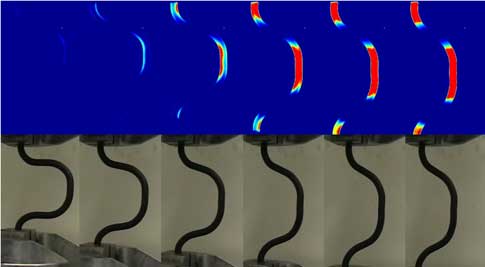
The Georgia Tech team found that the generation and absorption of heat during loading and unloading caused a temperature gradient in shape-memory alloys, which caused a nonuniform stress distribution in the material even when the strain was uniform.

“Shape-memory alloys previously examined in detail were really thin wires, which can exchange heat with the ambient environment rapidly and no temperature change is seen,” says Mirzaeifar. “When you start to examine alloys in components large enough to be used in civil engineering applications, the internal temperature is no longer uniform and needs to be taken into account.”

To predict the internal temperature distribution of shape-memory alloys under loading-unloading cycles, which could then be used to determine the stress distribution, the researchers developed a model that used the surface thermal boundary conditions, diameter, and loading rate of the alloy as inputs.

The team included ambient conditions in the model because shape-memory alloys for seismic applications could operate in a variety of environments—such as water, if used in bridge structures, or air if used in building structures—which would produce different rates of heat transfer. The researchers used a thermal camera to record the variation in surface temperature of shape-memory alloys experiencing loading and unloading.

Using their model, the researchers were able to accurately predict internal temperature and stress distributions for shape-memory alloys. The model results were verified with experimental tests. In one test, they found that a shape-memory alloy loaded at a very slow rate had time to exchange the heat created with the ambient environment and exhibited uniform stress. If it was loaded very rapidly, it did not have enough time to exchange the heat, leading to a nonuniform stress distribution.

“Our analytical solutions are exact, fast, and capable of simulating the complicated coupled thermo-mechanical response of shape-memory alloys considering temperature changes and loading rate dependency,” adds Mirzaeifar.

In future work, the researchers plan to examine more complicated shapes and the effects of combination loading—i.e., tension, bending, and torsion—to optimize shape-memory alloys for earthquake applications.

Discuss

About The Author

Georgia Institute of Technology’s picture

Georgia Institute of Technology

The Georgia Institute of Technology is one of the nation’s top research universities, distinguished by its commitment to improving the human condition through advanced science and technology. Georgia Tech’s campus occupies 400 acres in the heart of the city of Atlanta, where 20,000 undergraduate and graduate students receive a focused, technologically-based education.

You can create content!

  • Classifieds
  • File Share
  • Forum Topic
  • Events
  • Links

Sign In to get started!

Quality Information