Social Sharing block


As we know, GD&T is a symbolic language with which to specify permissible limits of imperfection in manufactured parts, namely limits that maximize the parts’ operability, assemblability, and affordability. It’s complex only to the extent that the real world of imperfect geometry is complex. If we’re dealing with a slightly tapered, slightly bent, slightly tilted, and slightly offset shaft, which is supposed to fit into a slightly, equally distorted mating bore, we need concepts, tools, and rules that can address those details. That’s GD&T.
The less clearly we deal with the concepts, tools, and rules of GD&T, the more complex and confusing the subject becomes, making it necessary to interpret poorly framed verbal statements and badly stuffed feature-control frames, instead of being able to simply decode clear statements and properly encoded feature control frames. Therefore, crystalline concepts, tools, and rules are essential to make GD&T work, and are the only way to turn the jungle of GD&T into a well-laid-out, formal garden.
The world of datums
The many concepts associated with the word “datum” represent a particularly important part of this jungle—oops, garden—and our purpose in this workshop is to define them so clearly that we can use them with confidence and communicate them clearly.
We’ll deal with these concepts in the following order:
- Datum feature
- Datum target
- Datum feature simulator (true geometric counterpart)
- Datum
- Datum reference frame
- Datum reference frame component
In each case we will provide the Y14.5 definition, followed by certain refinements for clarification.
By way of preparation, we show an overview of these many concepts in figure 1 below. The function of the bore in the lower right-hand corner of the CAD-defined part are encoded with the encircled feature-control frame, which references three datum features, of which A is a planar surface, B is a bore, and C is a slot. The associated datum feature simulators, A, B, and C are shown in blue in the lower left-hand corner of the figure, along with datums A, B, and C; and the datum reference frame they define, which is also shown transferred to the actual part in the lower right-hand corner of the figure.
Although the feature size modifier (S) is no longer required by the Y14.5M 1994 standard, its explicit use is still permitted and is highly recommended to prove that the designer had considered the (M) and (L) alternatives and selected the (S) intentionally.
|
Figure 1 – General Overview |
 |
1. Datum feature
Y14.5 1994 definition: “An actual feature of a part that is used to establish a datum.”
Refinements:
- What are datum features?
Specially labeled, physical features of real parts - What are datum features for?
They serve to constrain the rotational and translational degrees of freedom of parts relative to the mating features of mating parts, manufacturing fixtures or gauges
As shown in Figure 1, datum features are identified using datum feature labels, which consist of certain authorized capital letters of the alphabet and the datum feature symbol—a hollow or filled triangle that can be attached to the surface of the feature, to a leader or an extension line, or hung from the bottom of a feature-control frame. There are no datum labels, and the CAD defined features identified by datum feature labels are in fact “datum features,” not “datums.” Furthermore, contrary to a widely held misconception, the letters listed in the last compartment of a feature control frame also represent “datum features,” not “datums.” Simple proof of this is the fact that these letters are often associated with a material condition modifier (S), (M), or (L) (we like to refer to them as “tolerance zone mobility” modifiers to clearly represent their effects. See the previous article, "Tolerance Zone ’Size’ and ’Mobility’ Modifiers"), and only datum features have material associated with them. The points, axes, and planes representing datums have neither size nor material.
2. Datum target
Y14.5 1994 definition: “A specified point, line or area on a part used to establish a datum.”
Refinements:
- What is a datum target?
A specially-labeled portion of a datum feature in the form of a point, a line, or a limited area - What are datum targets for?
Datum targets serve to constrain the rotational and translational degrees of freedom of a part relative to the equally limited portions of a mating datum feature, or relative to the associated datum target simulators in a manufacturing fixture or a gauge.
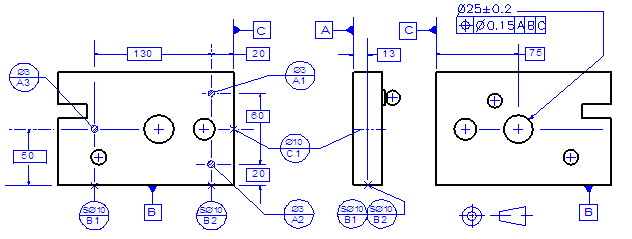
As shown in Figure 2 below, datum targets are identified using datum target labels. These consist of a circle with a horizontal bar, the lower half of which contains the name of the associated datum feature together with an incrementing number, and the upper half of which must contain the diameter of the spherical or cylindrical simulator in the case of a point or line datum target, and in the case of a circular or square area datum target, must contain its diameter or side length.
Datum targets should only be used when they represent the actual mating portions of mating datum features or the actual mating features of staging and manufacturing fixtures.
|
Figure 2 – Datum Targets |
 |
3. Datum feature simulator (true geometric counterpart)
Y14.5 1994 definition:
True geometric counterpart: “The theoretically perfect boundary (virtual condition or actual mating envelope) or best-fit (tangent) plane of a specified datum feature.”
Datum feature simulator: “A surface of an adequately precise form (such as a surface plate, a gauge surface, or a mandrel) contacting the datum feature(s) and used to establish the simulated datums.”
To simplify, we marry these two concepts and refer to conceptual datum feature simulators (perfect and imaginary) and physical datum feature simulators (as perfect as we need it and can afford them to be).
Refinements:
- What are datum feature simulators?
Datum feature simulators are “perfect” (that is “conceptually” perfect, or “physically” as perfect as we need and can afford them to be) inverse datum features. Datum feature simulators represent the datum feature engaging surfaces of manufacturing and gauging fixtures. Constraints on the size, form, orientation, and location of datum feature simulators are specified by the rules of datum feature simulation:
-
-
- Size: Datum feature simulators associated with the regardless-of-feature-size tolerance-zone mobility modifier (S), are required to expand or contract to consume all the available space in or outside the defining datum feature and achieve stability relative to it. Datum feature simulators associated with the maximum material condition (MMC) and least material condition (LMC) tolerance zone mobility modifiers (M) and (L), are required to be fixed in size at the virtual MMC boundary or virtual LMC boundary of the defining datum feature, respectively, leading to potential (M)obility or (L)ooseness relative to it. This rule will probably be slightly modified in the 2008 Y14.5 standard.
- Form: All datum feature simulators shall have “perfect” form.
- Orientation: All datum feature simulators shall be “perfectly” oriented relative to one another by the basic angles of their defining datum features.
- Location: All datum feature simulators shall be “perfectly” located relative to one another by the basic offsets of their defining datum features. This rule will probably be slightly modified in the 2008 Y14.5 standard.
-
- What are datum feature simulators for?
Datum feature simulators serve as a bridge between the imperfect real world of datum features and the perfect imaginary world of datums and datum reference frames. It’s from datum feature simulators that we extract datums. It’s in datum feature simulators that we establish datum reference frames, and it’s with datum feature simulators that we transfer datum reference frames to actual parts.
Figure 1 above shows the datum feature simulators, which are defined by the datum features referenced in the encircled feature-control frame. Note that the simulator for planar surface A is an inverted planar surface, that the simulator for bore B is an expanding shaft, and that the simulator for the slot is a tombstone fixed in size at the virtual MMC boundary, namely of thickness 16mm. In Figure 1 you’ll be able to see the relationship between the datum feature simulators and their associated datums.
4. Datum
Y14.5 1994 definition: “A theoretically exact point, axis, or plane derived from the true geometric counterpart of a specified datum feature. A datum is the origin from which the location or geometric characteristics of features of a part are established.”
Refinements:
-
- What are datums?
The minimum set of one perfect imaginary point, and/or one coincident axis, and/or one coincident plane, which together fully characterize the orientation and location of a perfect, conceptual, datum feature simulator. - What are datums for?
In special cases, a single datum can serve to orient and locate tolerance zones directly. In general, however, datums serve to constrain the rotational and translational degrees of freedom of a starter coordinate system, thereby turning it into a datum reference frame with which to then orient and locate tolerance zones.
- What are datums?
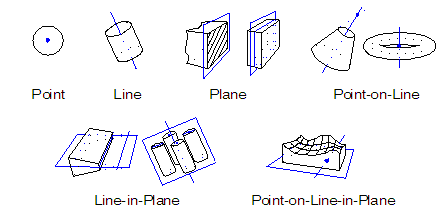
As illustrated in Figure 3 below, there are six datum types, each shown embedded in its defining datum feature simulator: a point, a line, a plane, a point-on-a-line, a line-in-a-plane and a point-on-a-line-in-a-plane.
|
Figure 3 – The Six Possible Datums |
 |
5. Datum reference frame
Y14.5 1994 definition: “Sufficient datum features, those most important to the design of a part, or designated portions of these features are chosen to position the part in relation to a set of three mutually perpendicular planes, jointly called a datum reference frame.”
Refinements:
- What are datum reference frames?
Datum reference frames are Cartesian coordinate systems, partially or wholly constrained by a set datums. - What are datum reference frames for?
Datum reference frames serve, with the help of basic dimensions, to orient and locate tolerance zones.
Although the fundamental datum reference frame is always a Cartesian coordinate system that consists of three mutually perpendicular axes, three mutually perpendicular base planes and a point representing the origin, a cylindrical, or a spherical coordinate system may be derived from it where required. The datum reference frame defined by the datum features referenced in the encircled feature control frame in Figure 1 is shown superimposed on the CAD model, buried in the simulator set, and established in the actual part.
6. Datum reference frame components
Y14.5 1994 definition: “ . . . A set of three mutually perpendicular planes . . .”
Refinements:
- What are datum reference frame components?
The components of a datum reference frame are its X,Y, and Z axes; its XY, YZ, and ZX base planes; and its XYZ origin. The labels identifying datum reference frame components should include a list of the datum features responsible for establishing the datum reference frame, as follows: X[A,B,C], . . . XY[A,B,C] . . . and XYZ[A,B,C]. - What are datum reference frame component labels for?
Datum reference frame components and their labels can be included in CAD models and in their associated 2-D representations to significantly accelerate the process of comprehending the datum reference frame defined by the datum features listed in a particular feature-control frame. Labeling datum reference frame components in a drawing also ensures that coordinate measuring machine generated reports coming from different laboratories present feature offsets in identically labeled formats.
For examples of datum reference frame components and their labels, see Figure 1.
Future articles
In our next workshop we’ll tackle the datum reference frame establishment process itself, the process defined by the datum features and tolerance zone mobility modifiers listed in a feature control frame, which requires a thorough understanding of all the concepts set forth in this workshop.
Feedback on topics of interest
We haven’t had any feedback from our Quality Digest readers in a long time. Are we boring you? Are we helping you? Please let us know how we are doing, but above all, what topics you would like us to address.
About the author
William Tandler is the founder of Multi Metrics, a provider of geometric dimensioning and tolerancing technology and corporate implementation services. Through its technology, training, and consulting products and services, Multi Metrics enables companies and individuals to actually realize the promise of GD&T.
Comments
Questions
Hi Mr William
I have one questions. In this case i have the compound datum, how use these informations for doing the program or interpret it?
These datums are not in the same dimensions.
Datum A (Primary)
Datum B ( Second)
And Datum C-D (Compound datum).
This information is the unique i have.
Thanks for you help
Any question let me knows
Best Regard
Ing. Fabiola C.
Add new comment