Inside Metrology

Bob Cramblitt  |  09/09/2010

Bob Cramblitt’s picture

Bio

3-D Scanning and Processing Technologies Help Ensure Safety of NASA Shuttle Discovery

Belly-up scanning at space station creates 3-D model of tiles crucial to orbit reentry

When the NASA Discovery space shuttle launches in November, there will be dozens of upgrades and safety modifications, but one thing will remain unchanged from every mission during the last five years: 3-D scanning and processing will be used to help ensure the safe return of astronauts to Earth.

As part of the Return to Flight initiative following the Columbia disaster in 2002, NASA implemented 3-D scanning and processing to detect, assess, and repair, if necessary, tile damage caused by foam particles dislodged from the shuttle and other flying debris.

Heat-resistant ceramic tiles that cover the underside of the shuttle Discovery are part of the thermal protection system that shields the orbiter and its astronauts from the 2,300°F-heat faced during re-entry into the Earth’s atmosphere.
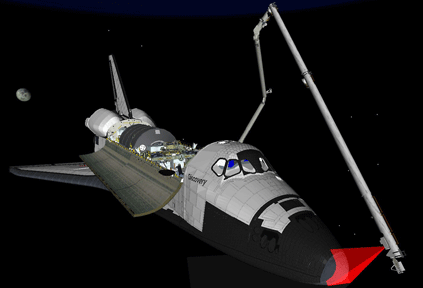
Simulation of the Neptec system scanning the Discovery shuttle. Image courtesy of Neptec.

The process of using 3-D scanning technologies to automatically transform physical objects into accurate 3-D digital models was implemented by NASA for the first time in August 2005 for the initial Discovery mission. After proving its value in that mission, it has become an integral part of NASA’s safety strategy.

Geomagic Studio software provides the central technologies for NASA’s implementation of 3-D scanning and processing for the inspection of the ceramic tiles. The software is used by major auto, aerospace, and consumer product manufacturers worldwide to digitally recreate complex physical objects for mass customization, more accurate analysis and simulation, and digital inventory. NASA uses Geomagic Studio to automatically process 3-D data collected from a scanner while the shuttle is in flight.

Scanning in space

The process of capturing and digitally re-creating tiles for the shuttle starts with a Neptec scanner mounted on a 50-foot extension of Discovery’s robot arm. Neptec’s Laser Camera System (LCS) uses a synchronized scanning technique patented by the National Research Council of Canada. According to Neptec, it can detect a crack as small as half a millimeter or twice the width of a standard business card from as far away as four meters. Unlike traditional cameras, it can operate without available light, a major consideration in space, where the sun rises and sets 16 times per day.

As the shuttle nears the space station for rendezvous, it rolls over to expose its underside for videotaping from the space station. Video surveys and detailed 3-D scanning inspections are conducted during the approach and docking to determine damage to the tiles underneath the wings.

A simulated repair of shuttle tile damage.  Image courtesy of Neptec.

“Tile damage is part of space travel,” says Kevin Scofield, a senior product manager at Geomagic. “Two-dimensional video can pick up some of it but the details are only discernable through 3-D analysis.”

Digitally replicating the damage

Scan data from the Neptec system is transmitted to NASA’s Johnson Space Center in Houston, where Geomagic Studio is used to process the data and create a 3-D model of the damaged tiles. Geomagic Studio provides patented algorithms that speed surface generation and ensure quality for highly detailed models. Because of its high level of automation, Geomagic Studio requires very little training; a logical workflow enables users to maintain proficiency even if they don’t work with the software on a daily basis.

Photograph of shuttle tile damage from a Discovery shuttle mission.  Courtesy of NASA.

The 3-D surface model created in Geomagic Studio is used by NASA engineers to assess the level of damage to the tiles. If the digital model indicates a safety threat, engineers create a tool path to replicate the damage on an array of test tiles. The reproductions of the damaged tiles are tested in NASA’s ArcJet facility to see if they can withstand the heat and stress of reentry. If damage is considered too extensive for safe reentry, the situation could call for a spacewalk by astronauts to make the repair. In this case, the test tiles would be used to develop the step-by-step repair process.

A digital reconstruction of tile damage automatically created in Geomagic Studio based on data captured from a Neptec scanner mounted on a 50-foot extension of Discovery’s robot arm.

An application best not used

Fortunately, in-flight repair has not been necessary in previous Discovery flights, as analysis of scan data showed that damage was not severe enough to put the orbiter at risk during reentry.

“As proud as we are to be a part of Discovery missions, we’re keeping our fingers crossed that Geomagic Studio is never used to manufacture test tiles for a spacewalk repair during an actual mission,” says Scofield.

Discuss

About The Author

Bob Cramblitt’s picture

Bob Cramblitt

Bob Cramblitt is a writer and communications professional specializing in computer graphics, CAD/CAM, performance benchmarking and IT issues. He’s based in Cary, North Carolina.

You can create content!

  • Classifieds
  • File Share
  • Forum Topic
  • Events
  • Links

Sign In to get started!

Quality Information