![]() |
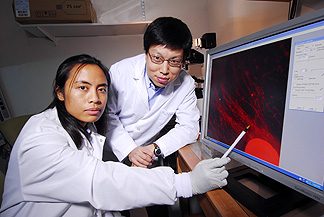
Yadong Wang, assistant professor in the Coulter Department of Biomedical Engineering at Georgia Tech and Emory University (right), and graduate student Christiane Gumera (left) have developed a potentially promising strategy for encouraging the regeneration of damaged central nervous system neurons. Gumera points to a fluorescence image that indicates the presence of proteins required for nerve regeneration. Photo by Gary Meek |
Research reported recently in the journal Advanced Materials describes a potentially promising strategy for encouraging the regeneration of damaged central nervous system cells known as neurons.The technique would use a biodegradable polymer containing a chemical group that mimics the neurotransmitter acetylcholine to spur the growth of neurites, projections that form the connections among neurons and between neurons and other cells. The biomimetic polymers would then guide the growth of the regenerating nerve.
There is currently no treatment for recovering human nerve function after injury to the brain or spinal cord because central nervous system neurons have a very limited capability for self-repair and regeneration.
“Regeneration in the central nervous system requires neural activity, not just neuronal growth factors alone, so we thought a neurotransmitter might send the necessary signals,” says Yadong Wang, assistant professor in the Coulter Department of Biomedical Engineering at Georgia Tech and Emory University, and principal investigator of the study. The research was supported by Georgia Tech, the National Science Foundation and the National Institute of Biomedical Imaging and Bioengineering (NIBIB).
Chemical neurotransmitters relay, amplify, and modulate signals between a neuron and another cell. This new study shows that integrating neurotransmitters into biodegradable polymers results in a biomaterial that successfully promotes neurite growth, which is necessary for victims of central nervous system injury, stroke, or certain neurodegenerative diseases to recover sensory, motor, cognitive, or autonomic functions.
Wang and graduate student Christiane Gumera developed novel biodegradable polymers with a flexible backbone that allowed neurotransmitters to be easily added as a side chain. In its current form, the polymer would be implanted via surgery to repair damaged central nerves.
“One of our ultimate goals is to create a conduit for nerve regeneration that guides the neurons to regenerate, but gradually degrades as the neurons regenerate so that it won’t constrict the nerves permanently,” explains Wang.
![]() |
Phase-contrast micrograph of a ganglion on a 70 percent acetylcholine polymer that shows neurite growth. The figure is merged from a series of 100x magnification image. Image courtesy of Christiane Gumera |
For the experiments, the researchers tested polymers with different concentrations of the acetylcholine-mimicking groups. Acetylcholine was chosen because it is known to induce neurite outgrowth and promote the formation and strengthening of synapses—connections between neurons. They isolated ganglia nervous tissue samples, placed them on the polymers and observed new neurites extend from the ganglia.
Since these neuron extensions must traverse a growth-inhibiting material in the body, Wang and Gumera tested the ability of the biomaterial to enhance the extension of sprouted neurites. More specifically, they assessed whether the ganglia sprouted at least 20 neurites and then measured neurite length and neurite length distribution with an inverted phase contrast microscope.
“We found that adding 70 percent acetylcholine to the polymer induced regenerative responses similar to laminin, a benchmark material for nerve culture,” says Wang. Seventy percent acetylcholine also led to a neurite growth rate of up to 0.7 millimeters per day, or approximately half the thickness of a compact disc.
![]() |
Fluorescence micrograph of a ganglion on a 70 percent acetylcholine polymer that shows neurites expressing an established neuronal marker called synaptophysin. The bright red spots on the neurites indicate the presence of synaptic vesicle proteins, which are required for functional restoration after nerve injury. Image courtesy of Christiane Gumera |
Laminin is a natural protein present in the nervous tissues, but it dissolves in water, making it difficult to incorporate into a conduit that needs to support nerves for months. A synthetic polymer with acetylcholine functional groups, on the other hand, can be designed to be insoluble in water, according to Wang.
Since functional restoration after nerve injury requires synapse formation, the researchers also searched for the presence of synaptic vesicle proteins on the newly formed neurites. With fluorescence imaging, they found that neurons cultured on these acetylcholine polymers expressed an established neuronal marker called synaptophysin.
To provide insights into new approaches in functional nerve regeneration, the researchers are currently investigating the mechanisms by which the neurons interact with these polymers. Since neurons that remain intact after severe injury have only a limited capacity to penetrate the scar tissue, these new findings in nerve regeneration could help compensate for the lost connections.
“This polymer and approach aren’t limited to nerve regeneration though, they can probably be used for other neurodegenerative disorders as well,” adds Wang.
This work was funded by grant number R21EB008565 from the NIBIB of the National Institutes of Health. The content is solely the responsibility of the authors and does not necessarily represent the official view of the NIBIB or the NIH.
This article was originally published by Georgia Tech Research News.